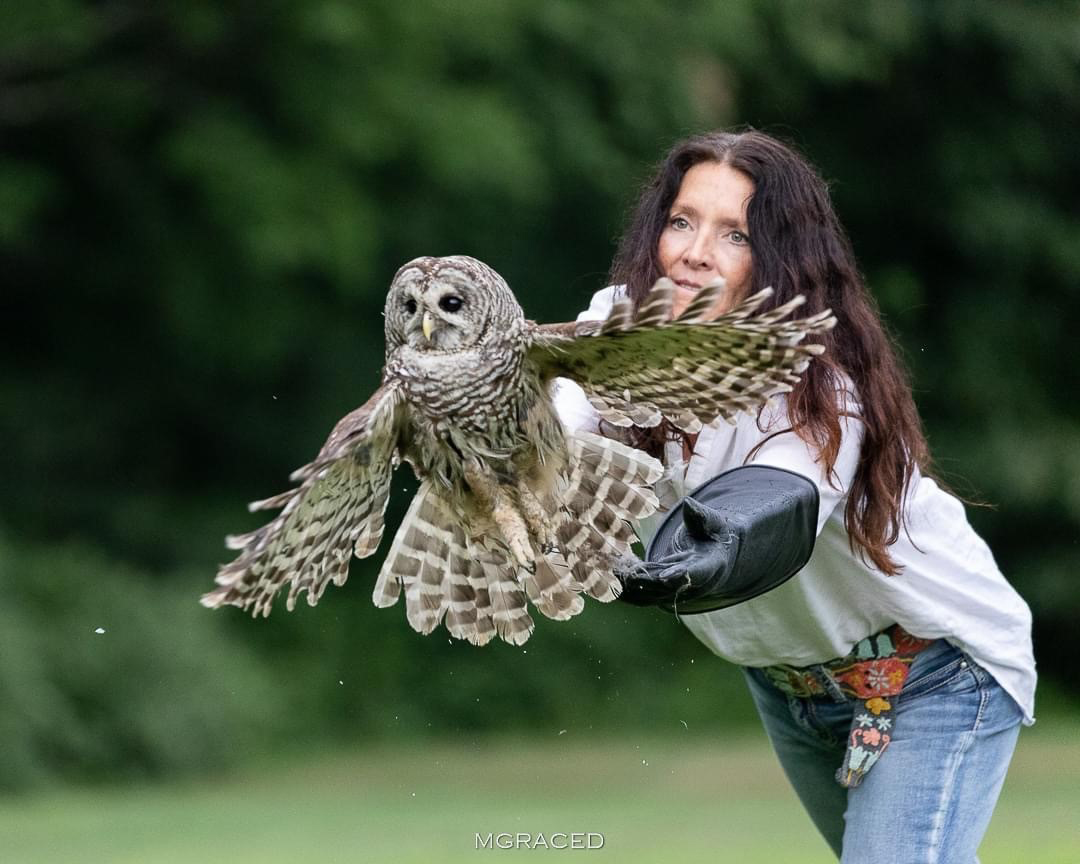
Jane Kelly of On the Wing
‘The human impact on wildlife is pretty insane,’ says Jane Kelly, founder of On the Wing, a birdof-prey rescue center in Epping. She’s shown here releasing a great horned owl. (Courtesy photo)
Though she has a profound love of nature and has trained as a falconer, Jane Kelly hadn’t planned on founding the thriving bird-of-prey rescue center On the Wing. But the mission found her more than a decade ago.
“I was crossing paths with these birds,” she explained on the discovery of dead owls by various roadsides in the Epping area, where On the Wing was started. They were hit by cars at night because the owls were close to the ground searching for food, mainly rodents.
“The human impact on wildlife is pretty insane,” said Kelly, a Wisconsin native who studied textile design and owned a small chain of retail stores. Before starting On the Wing, she began rehabilitating injured birds of prey and other bird species at her home. The organization has grown and become an integral part of a bird rehabilitation infrastructure in northern New England that she believes is needed more than ever. She says the phone app AnimalHelpNow has also helped people immediately connect anywhere with rehabilitation organizations like On the Wing.
Q. What is the genesis of On the Wing?
A. I grew up hunting and fishing with my dad and love the outdoors, but I had no background in this, and I’m not an ornithologist. It started when, over a twomonth period, I found 10 dead owls by the side of the road on Route 101. They were all car strikes. I was crossing paths with these birds, and I decided to rehabilitate the injured ones at my home.
Q. Why are so many birds of prey found injured or dead along roadsides?
A. They are hunting and focused on prey like rodents who are often scavenging food thrown out along roadsides by people. They are easily blindsided by drivers who don’t see them. Garbage is a big problem as you can see along roads and highways in New Hampshire and Massachusetts.
Q. How many bird species do you treat, and how long do they stay?
A. We’ve treated up to 400 birds a year, and have been blessed to work with the Veterinary Emergency and Surgery Hospital in Brentwood who can treat birds 24/7.
We treat species ranging from all types of owls and hawks to Ruby Crowned Kinglets and Green Herons to pileated woodpecker, probably 100 different species. Because each bird that arrives is at a different stage of recovery, the typical length of time here can range from 24 hours to four months. As the word about our work has spread, the number of calls we get has increased. Last year we felt the growing pains, and we’re working on raising funds to expand our indoor and outdoor caging.
Q. How is the increased use of rodenticides affecting the birds On the Wing cares for?
A. Car strikes are the No. 1 killer and injurer of birds, but the increase of rodenticides has become a really, really big deal for birds of all types who eat rodents and other animals who have been poisoned. If we catch it early enough, we can treat the birds with Vitamin K shots and recovery rehabilitation. If not, it kills birds of prey slowly, causing internal hemorrhaging and then organ failure. It’s our era’s equivalent of DDT, and it’s reprehensible. We are asking people to reach out to their state representatives to ban these poisons.
Q. How do you fund operations for On the Wing?
A. We have a great team of volunteers and interns, including an international intern apprentice. We raise money through personal donations and through the many off-site educational programs with the 10 birds of prey who live here. We go to schools, libraries, assisted living facilities, and special events like birthday parties.
Q. What do you find most rewarding about this work?
A. One of the most rewarding parts of what we are doing is seeing how these birds touch folks of all ages. It’s very moving how nature keeps us humble, and there’s always something important to be learned from each species
Q. When you release a bird of prey after rehabilitation, do they ever return?
A. We return them to the area where they were found. There could be the relief of ‘Gosh it’s great to get out of here’ on their part, but I’ve never had one return.