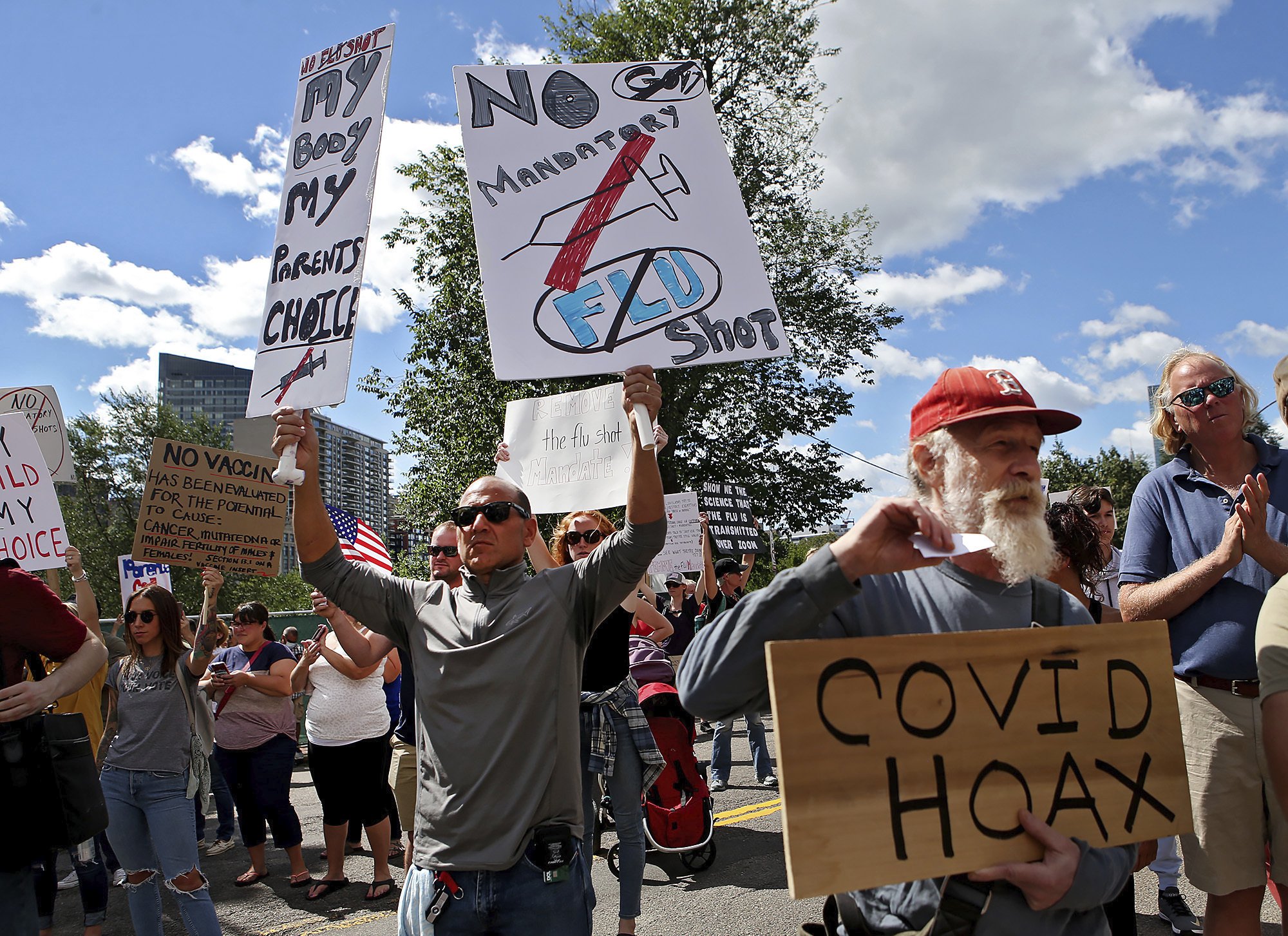
Why do some NH healthcare workers oppose the Covid-19 vaccine?
The
number of Covidpositive healthcare workers hasn’t stopped a vocal group
of nurses and others in the industry from loudly objecting to
vaccination requirements, even at risk of losing their jobs.
Since the pandemic began, 5,862 healthcare workers have contracted Covid-19 in New Hampshire, 87 have been hospitalized and 10 have died, according to state statistics.
But that hasn’t stopped a vocal group of nurses and others in the medical industry from loudly objecting to vaccination requirements, even at the risk of losing their jobs.
The Biden administration is requiring Covid-19 vaccinations for staff at Medicare- and Medicaid-certified facilities to protect them and patients from the virus and its more contagious Delta variant. It has also ordered the Occupational Safety and Health Administration to draft a rule requiring employers with at least 100 workers to force employees to get vaccinated or produce weekly test results showing they are virus free.
Registered nurse Terese Grinnell has been outspoken against Covid-19 vaccination mandates. She previously worked at Concord Hospital, Dartmouth-Hitchcock and the Concord Regional Visiting Nurse Association. She declined to state her present employer, but said she works with critically ill patients.
Grinnell has organized regular protests outside Concord Hospital. She’s posted photos of protests involving about a dozen people outside the hospital. Grinnell said other nurses and healthcare professionals have joined in.
She
has called for the impeachment of Republican Gov. Chris Sununu. She
reposted an article that compared mask mandates to the Holocaust, and
included a graphic of syringes formed to shape a Nazi swastika.
Beginning activism
Grinnell
said she began her activism after learning a pregnant nursing student
was being required to take the inoculation in order to continue her
education program.
“I
have a lot of friends who are not comfortable with the injection,” she
said in an interview. “They’ve seen patients with adverse reactions. It
has not been out long enough and many of us lived through Covid
outbreaks in the hospital, many of us have had Covid, and it doesn’t
make any sense that we would have to put something man-made into our
systems, and yet we’re losing our livelihoods over it.”
The
U.S. Centers for Disease Control and Prevention says the vaccine is
safe and effective, and that the benefits of receiving the vaccination,
including during pregnancy, far outweigh extremely rare side effects.
The
CDC also says the vaccine was thoroughly researched and tested and is
subject to the most intense safety monitoring program in U.S history. It
also recommends the vaccine for those who have already had the virus,
saying people get better protection by being fully vaccinated.
This advice is supported by
the state Department of Health and Human Services, the American Medical
Association, the American College of Obstetrics and Gynecology, the
Society for Maternal-Fetal Medicine and the American Nurses Association,
among others.
While
the vaccine was developed rapidly, efficacy and safety protocols of
clinical trials, assessment of data and Food and Drug Administration
authorization and approval were followed.
The
process was sped by years of experience with similar diseases, decades
of research on mRNA technology used in the vaccine, early sequencing of
the virus genome, clinical testing stages done in parallel rather than
one at a time and billions of dollars in government investment,
including in manufacturing and distribution. Government red tape was
also cut in some instances.
Other vaccines
Grinnell
said she and her children have taken other vaccinations, but she said
she simply doesn’t believe the conventional wisdom about the importance
of receiving this one.
“My
intuition tells me that, based on what I’ve seen and my own evidence,
my own patient experiences and then my research that I’ve done, my
intuition tells me there is no rational reason for me to be doing this
to my body at this time,” Grinnell said.
She said this view should be accepted, and medical staff shouldn’t be required to receive a vaccine as a condition of employment.
Grinnell compared her stance to that of Jehovah’s Witnesses who refuse blood transfusions.
She
said that, similarly, her refusal to take the vaccine is a personal
decision. She rejects the notion that during a global pandemic, one’s
decision to remain unvaccinated affects others throughout society.
“The
vaccine is 95 percent effective to reduce your symptoms, but you can
still contract and you can still transmit, just as much as the
unvaccinated,” she said. “So, we’re operating under a lie.”
The
CDC says the risk of infection, hospitalization and death are all much
lower in vaccinated people compared to the unvaccinated. Unvaccinated
people remain the biggest concern.
“The
greatest risk of transmission is among unvaccinated people who are much
more likely to get infected, and therefore transmit the virus,” the CDC
says. “Fully vaccinated people get Covid-19 (known as breakthrough
infections) less often than unvaccinated people.”
Grinnell
said that if she were to get the virus, she wouldn’t be a danger to her
patients, since she tests regularly, would stay home after a positive
test or symptoms, and wears personal protective equipment that would
prevent transmission of the disease.
Grinnell
also said ivermectin has not been sufficiently used to combat the
virus. Ivermectin is an anti-parasitic medication not authorized or
approved by the FDA for use in preventing or treating Covid-19.
Executive Council
Shouting
“Shut it down!,” she and other protesters forced postponement of a
Sept. 29 meeting of the Executive Council, which was to consider taking
$27 million in federal funding to boost vaccination efforts. Sununu said
the protesters exhibited “unacceptable, unruly behavior.”
Jake
Leon, a spokesman for the state Health and Human Services Department,
said the funding will be instrumental to ongoing statewide efforts to
ensure access to the vaccine.
“This
funding will also allow the Department and regional public health
partners to expand our ability to make the vaccine accessible when
additional vaccines are approved for a third dose for people over 65 and
immunocompromised individuals, and when children 5 to 1 years old
become eligible to receive it,” he said.
“The department will need approval by the Executive Council and Legislative Fiscal Committee to accept and expand the funding.”
Rep.
Ken Weyler, R-Kingston, recently stepped down from his role as chair of
that committee after distributing information with conspiracy theories
about Covid-19, including one that the vaccine contained a “living
organism with tentacles.”
Sununu called for Weyler to lose his leadership role.
Sununu’s position
The governor also commented on one of Grinnell’s Facebook posts, which called for him to block vaccine mandates.
Sununu
says that while he doesn’t support such mandates, it is not within his
power to tell private businesses what they may require of their
employees.
“The
government can’t infringe on the rights of a private business and tell a
private entity who to hire and fire,” he said. “Even if we don’t agree,
there are limits to government overreach. If you believe that the
government must ensure you don’t get fired from your employer. I’m
sorry, but that’s not right. Having a specific job with a specific
private employer is not an inalienable right of freedom.”
Vaccine support
Pamela
P. DiNapoli, a registered nurse who is executive director of the New
Hampshire Nurses Association, said only a fraction of healthcare workers
oppose Covid-19 vaccinations.
An
AMA survey showed more than 96 percent of doctors have been vaccinated.
The American Nurses Association reports that 88 percent of nurses in
the U.S. are vaccinated.
“When
you talk to the public, they might think there are a lot of nurses who
have not been vaccinated,” DiNapoli said. “But in our talking to nurses,
before the mandate, maybe 80 percent of the nurses had voluntarily been
vaccinated, and now another 10 percent have been vaccinated, so maybe
10 percent have not been vaccinated.”
‘My
intuition tells me there is no rational reason for me to be doing this
to my body at this time,’ says Terese Grinnell, a registered nurse.
She said there has not been a significant number of nurses who have resigned rather than take the vaccine.
DiNapoli
added that hospitals have been providing education and training for
nurses who are hesitant to receive the vaccine, or who still have
questions such as the inoculation’s effect on fertility.
The CDC says there is no evidence showing that any vaccines, including Covid-19 vaccines, cause fertility problems.
Other
questions revolve around whether the mandate allows a face mask to be
worn instead of receiving a vaccination. The answer is no.
And
some want to know if they can get a religious exemption from the
mandate. This would technically be possible, but only if there was a
specific and verified religious prohibition, DiNapoli said. There is no
“conscientious objector” exemption.
“They
(hospitals) are doing individual education, really encouraging
understanding of the science and not the misinformation, and then the
nurses are going to have a choice whether or not they are going to stay
or move to another organization that maybe is not mandating the
vaccine,” she said.
Conflicted nurses
DiNapoli
also said nurses sometimes are conflicted when they see unvaccinated
people come down with serious cases of the disease. The majority of the
people hospitalized for Covid-19 are unvaccinated.
“You
have a preventable disease, and now you’re straining my resources,
you’re straining resources from people who have a heart attack, stroke,
who need those beds,” she said.
Of
the more than 50,000 Covid-19 cases reported in New Hampshire over the
past eight months, only 3 percent involve people who were vaccinated,
according to state statistics.
“The nurses who are vaccinated can’t understand those who are not vaccinated,” DiNapoli said.
She also said there is a code of ethics in nursing requiring “justice and do no harm.”
“You
have, by virtue of your license, said that you will do no harm, and we
know by the science that you could potentially harm children who can’t
get vaccinated and the immunocompromised,” she said.
DiNapoli
said she hopes to reach people who are vaccine-hesitant, but feels she
doesn’t have much opportunity to change the mind of true vaccine
opponents, including those in the New Hampshire legislature, science
notwithstanding.
She
also acknowledged that there is already a shortage of nurses, which
could be exacerbated if some nurses refuse to abide by a vaccine
requirement.
There are 50,000 licensed nurses in the state, and Di- Napoli said she has not heard of one who has had serious side effects.
Political divide
Mindi
Messmer of the New Hampshire Science and Public Health Task Force said
she supports vaccination mandates for health professionals and others
“based on the fact that unvaccinated individuals nationally and in New
Hampshire are more likely to be infected, have higher levels of the
virus in their nasal passages, and therefore transmit the virus.”
Surveys
have shown a correlation between vaccination rates and political
beliefs. Joe Biden supporters are more likely than Donald Trump
supporters to be vaccinated, although Trump himself was vaccinated after
being hospitalized with Covid-19.
“It
is disconcerting that some healthcare professionals are choosing
political beliefs over data to inform their choices regarding the
Covid-19 vaccine,” Messmer said.
As
of Oct. 13, 54.5 percent of New Hampshire residents were fully
vaccinated against the virus, 59.8 percent received at least one dose of
the vaccine, 1,497 have died of Covid-19 in the state and 700,000 have
died across the nation.
This article is being shared by partners in the Granite State News Collaborative. For more information visit, collaborativenh.org.
Even with potential of losing their jobs, some medical professionals loudly object to requirements.