Dover High program helps students cultivate a much-indemand career
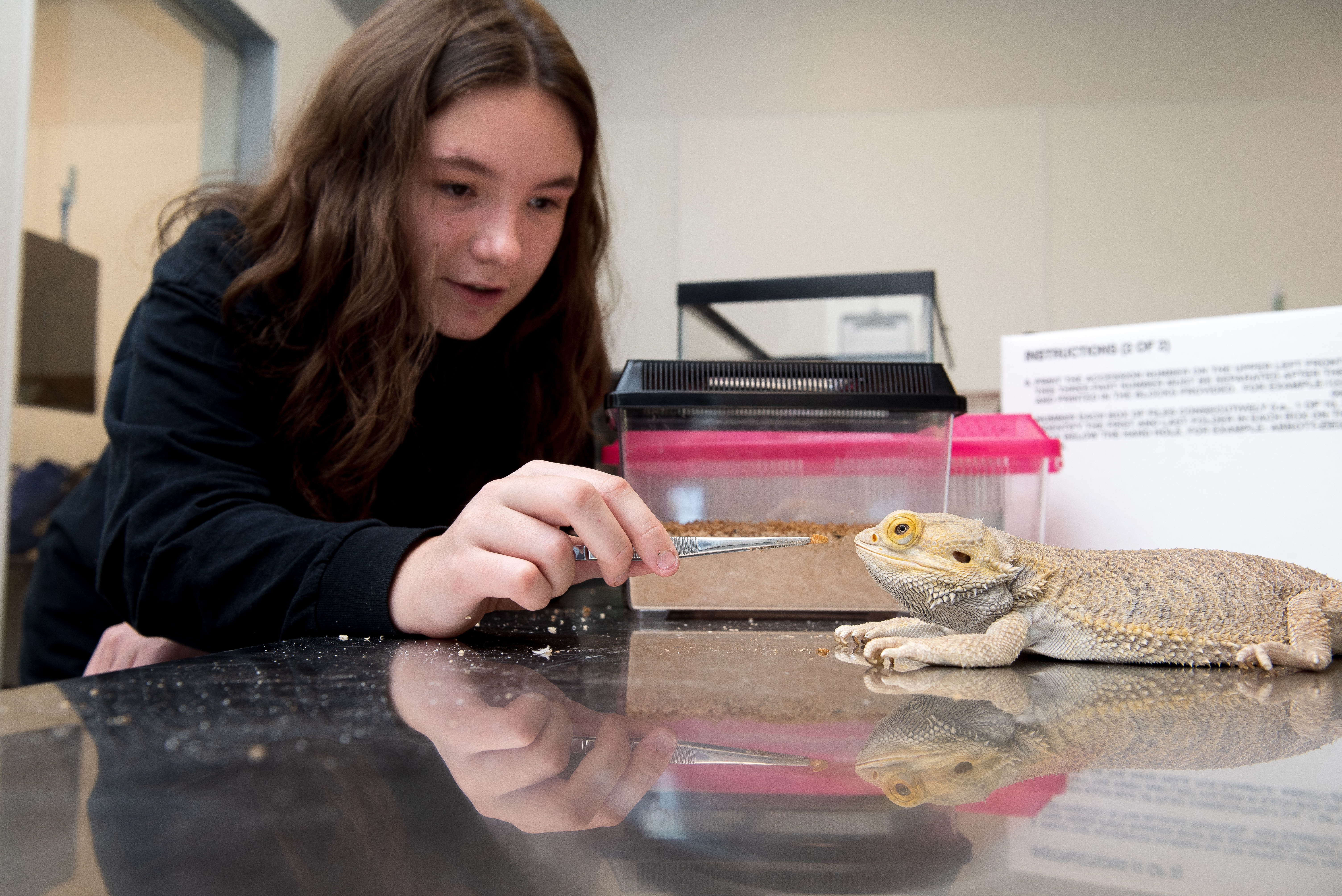
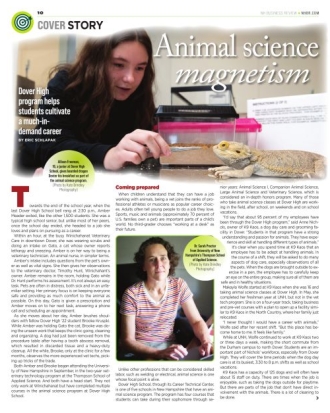
Allison Freeman, 16, a junior at Dover High School, gives bearded dragon Dexter his breakfast as part of the animal science program. (Photo by Kate Brindley Photography) Towards the end of the school year, when the last Dover High School bell rang at 2:30 p.m., Amber Meader exited, like the other 1,500 students. She was a typical high school senior, but unlike most of her peers, once the school day ended, she headed to a job she loves and plans on pursuing as a career.
Within an hour, at the busy Winichahanat Veterinary Care in downtown Dover, she was wearing scrubs and doing an intake on Gato, a cat whose owner reports lethargy and sneezing. Amber is on her way to being a veterinary technician. An animal nurse, in simpler terms.
Amber’s intake includes questions from the pet’s owner as well as vital signs. She then gives her observations to the veterinary doctor, Timothy Hunt, Winichahant’s owner. Amber remains in the room, holding Gato while Dr. Hunt performs his assessment. It’s not always an easy task. Pets are often in distress, both sick and in an unfamiliar setting. Her primary focus is on keeping everyone safe and providing as much comfort to the animal as possible. On this day, Gato is given a prescription and Amber moves on to her next task, answering a phone call and scheduling an appointment.
As she moves about her day, Amber brushes shoulders with fellow Dover High ‘22 student Brooke Kruspki.
While Amber was holding Gato the cat, Brooke was doing the unseen work that keeps the clinic going, cleaning and organizing. A dog had just been removed from the procedure table after having a tooth abscess removal, which resulted in discarded tissue and a heavy-duty cleanup. All the while, Brooke, only at the clinic for a few months, observes the more experienced vet techs, picking up tricks of the trade.
Both Amber and Brooke began attending the University of New Hampshire in September, in the two-year veterinary technology program at the Thompson School of Applied Science. And both have a head start. They not only work at Winichahanat but have completed multiple courses in the animal science program at Dover High School.
Coming prepared
When children understand that they can have a job working with animals, being a vet joins the ranks of professional athletes or musicians as popular career choices. Adults often tell young people to do a job they love.
Sports, music and animals (approximately 70 percent of U.S. families own a pet) are important parts of a child’s world. No third-grader chooses “working at a desk” as their future.
Unlike other professions that can be considered skilled labor, such as welding or electrical, animal science is one whose focal point is alive.
Dover High School, through its Career Technical Center, is one of five schools in New Hampshire that have an animal science program. The program has four courses that students can take during their sophomore through senior years: Animal Science I, Companion Animal Science, Large Animal Science and Veterinary Science, which is considered an in-depth honors program. Many of those who take animal science classes at Dover High are working in the field, after school, on weekends and on school vacations.
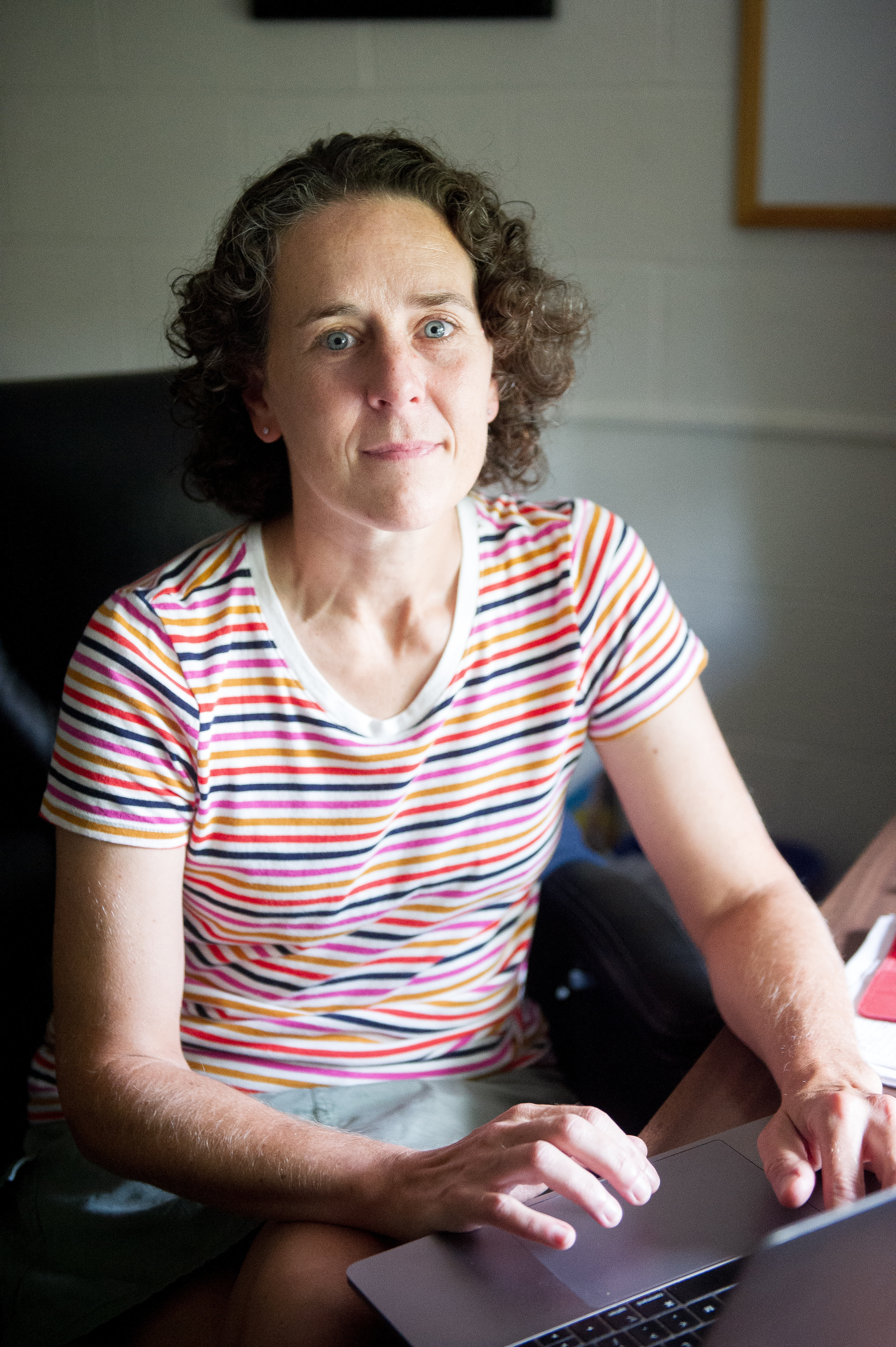
Dr. Sarah Proctor from University of New Hampshire’s Thompson School of Applied Science. (Photo by Kate Brindley Photography)
“I’d say that about 95 percent of my employees have been through the Dover High program,” said Anne Nichols, owner of K9 Kaos, a dog day care and grooming facility in Dover. “Students in that program have a strong understanding and passion for animals. They have experience and skill at handling different types of animals.”
It’s clear when you spend time at K9 Kaos that an employee has to be adept at handling animals. In the course of a shift, they will be asked to do many aspects of dog care, especially observations of all the pets. When the dogs are brought outside to exercise in a pen, the employee has to carefully keep an eye on the entire group, making sure all of them are safe and in healthy situations.
Makayla Wolfe started at K9 Kaos when she was 16 and taking animal science classes at Dover High. In May, she completed her freshman year at UNH, but not in the vet tech program. She is on a four-year track, taking business and pre-vet courses with a plan to open up a facility similar to K9 Kaos in the North Country, where her family just relocated.
“I never thought I would have a career with animals,” Wolfe said after her recent shift. “But this place has become home to me. It feels like family.”
While at UNH, Wolfe continued to work at K9 Kaos two or three days a week, making the short commute from the Durham campus to north Dover. Students are an important part of Nichols’ workforce, especially from Dover High. They will cover the time periods when the dog day care is at its busiest, 3:30 to 8 p.m. shifts as well as school vacations.
K9 Kaos has a capacity of 125 dogs and will often have about 15 staff on duty. There are times when the job is enjoyable, such as taking the dogs outside for playtime. But there are parts of the job that don’t have direct involvement with the animals. There is a lot of cleaning to be done.
“When I meet with high school students, we talk about the fact that the job is not just playing with dogs,” Nichols said. “That is one of the great things about the animal science program at Dover High — the students are prepared for all aspects of the business.”
‘An intense class’
Carrie Hough and Katie Green are the two animal science teachers at Dover High School. Their day is spent in The Barn, a separate facility about a hundred yards from the high school. In it are multiple classrooms including areas that simulate a vet medical room, a room that houses reptiles, birds and gerbils, plus a collection of stalls that house animals such as alpacas, cows and goats. There is a lot of energy in The Barn. Students will count the minutes until math class ends so work with animals can begin.
“Our primary goal in animal science here at Dover High is to train good pet owners, so they can recognize good and bad situations and provide basic needs to animals,” said Green. “But we also provide opportunities for careers with animals.”
Green teaches the honors vet science class, which is considered one of the more difficult courses that students can take at Dover High. This class is also part of the Running Start program, which allows dual credit for both high school and Great Bay Community College. Most of those students in the honors class will go on to a fouryear college or the two-year program at UNH or Great Bay.
“I want to keep up the rigor and focus on what they need to be successful in the industry,” added Green, who has multiple degrees in the animal science field from Cornell University.
“It’s an intense class,” said Dover senior Nadyan Byrnes. “There is a lot of information and Ms. Green works us hard. But fair. She and Ms. Hough are my favorite teachers at Dover High.”
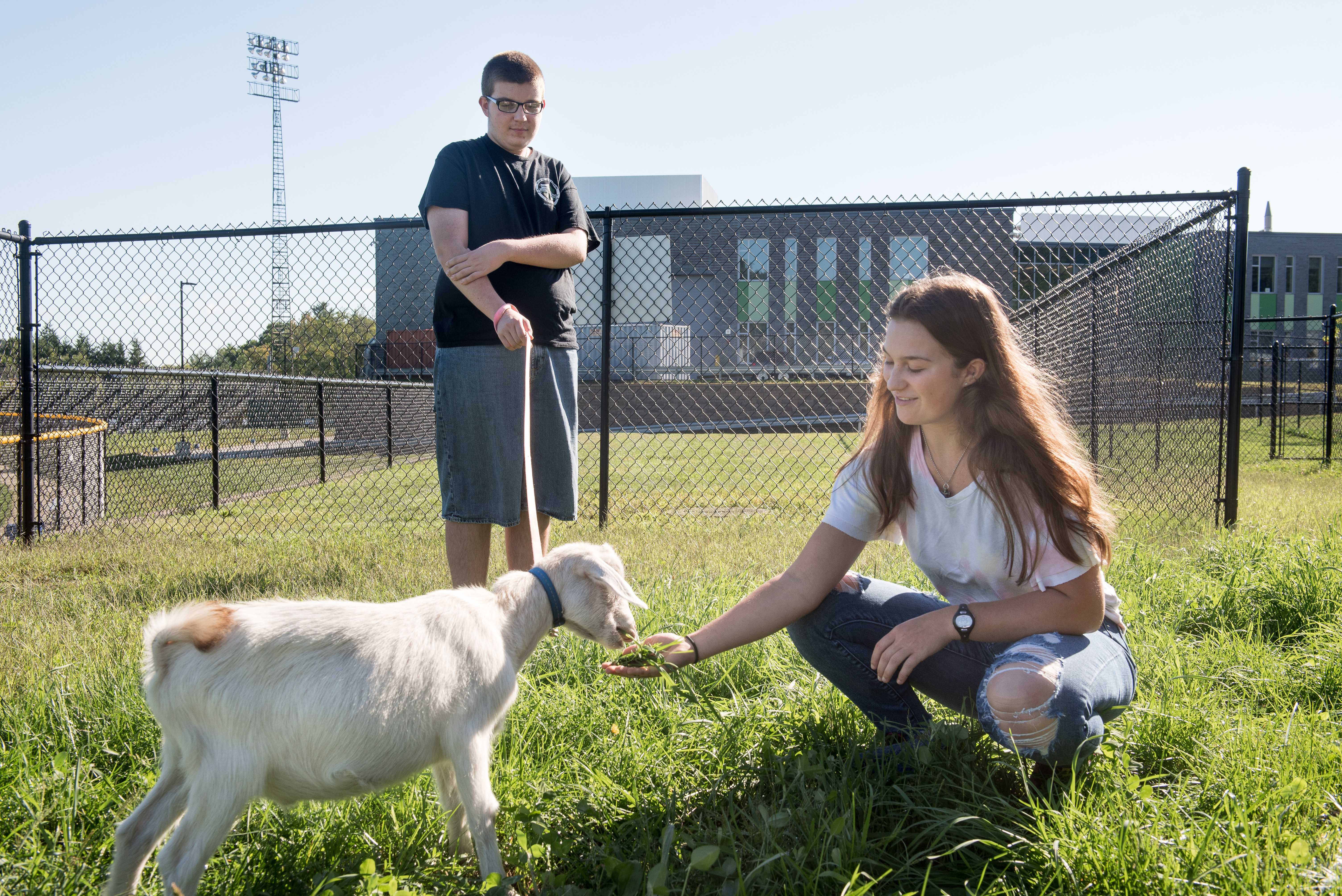
Stripe the goat enjoys a morning snack with Dover High School seniors Cody Tatro, 17, and Jenavee Johnson. (Photo by Kate Brindley Photography)
Nadyan has grown up with animals, especially horses.
She teaches horseback riding at Green Acres Stables in Madbury. After graduation, she is heading to Fort Jackson, S.C., for NH Army National Guard boot camp.
“I’m still sorting out exactly what I want to do,” Nadyan said after changing the food for a goat in The Barn. “Animals are an important part of my life. The program has also given me confidence in public speaking and working in groups. Before I started the animal science program I liked to work by myself and was quiet. Now I’ll talk in front of anyone, and I feel ready for the National Guard and beyond.”
Ava Albies, a 2022 DHS grad, echoes that sentiment.
“We get lots of experience working with different people. Even if they are unfamiliar or someone you don’t think you like. We learn right away it’s a team effort and all about the animals.”
Brooke says that being part of the Dover animal science program has been very helpful in her work at Winichahanat.
“Ms. Green helped us with so many things. I know the anatomy of animals. Plus doing things like IVs and catheters. And Ms. Hough taught us all about the different breeds and their characteristics. So when a pet comes into the clinic, I know some background.”
‘The market is desperate’
Ava will be joining Brooke and Amber as the three Dover High students who will be starting the vet tech program at UNH’s Thompson School this fall. They are all excited to be taking the next step on their journey to a career with animals.
Sarah Proctor is a veterinary doctor who is program coordinator of the nationally recognized vet tech program at UNH. The Cornell and UNH-trained Proctor has been with the program for its entire 10 years.
“We have a lot to pack in during the two years,” Proctor said. “It’s a competitive program to get accepted to and we have a high bar for admissions.”
Most UNH vet tech grads go into the industry, but some transfer into the four-year UNH animal science program. There are about 50 students in the program, though Proctor wishes it would be more.
“The market is desperate. Everyone is hiring. There is a shortage of vet techs. Almost all have full-time career job offers long before they graduate.”
These vet techs are professionals with extensive classroom and clinical experience. While they are at UNH, the students have different opportunities to actively participate in animal care.
On campus, there is the PAWS Teaching Clinic, where students move through the types of assignments they will get in a full-time vet clinic.
These are similar to rotations that a medical doctor or nurse would get.
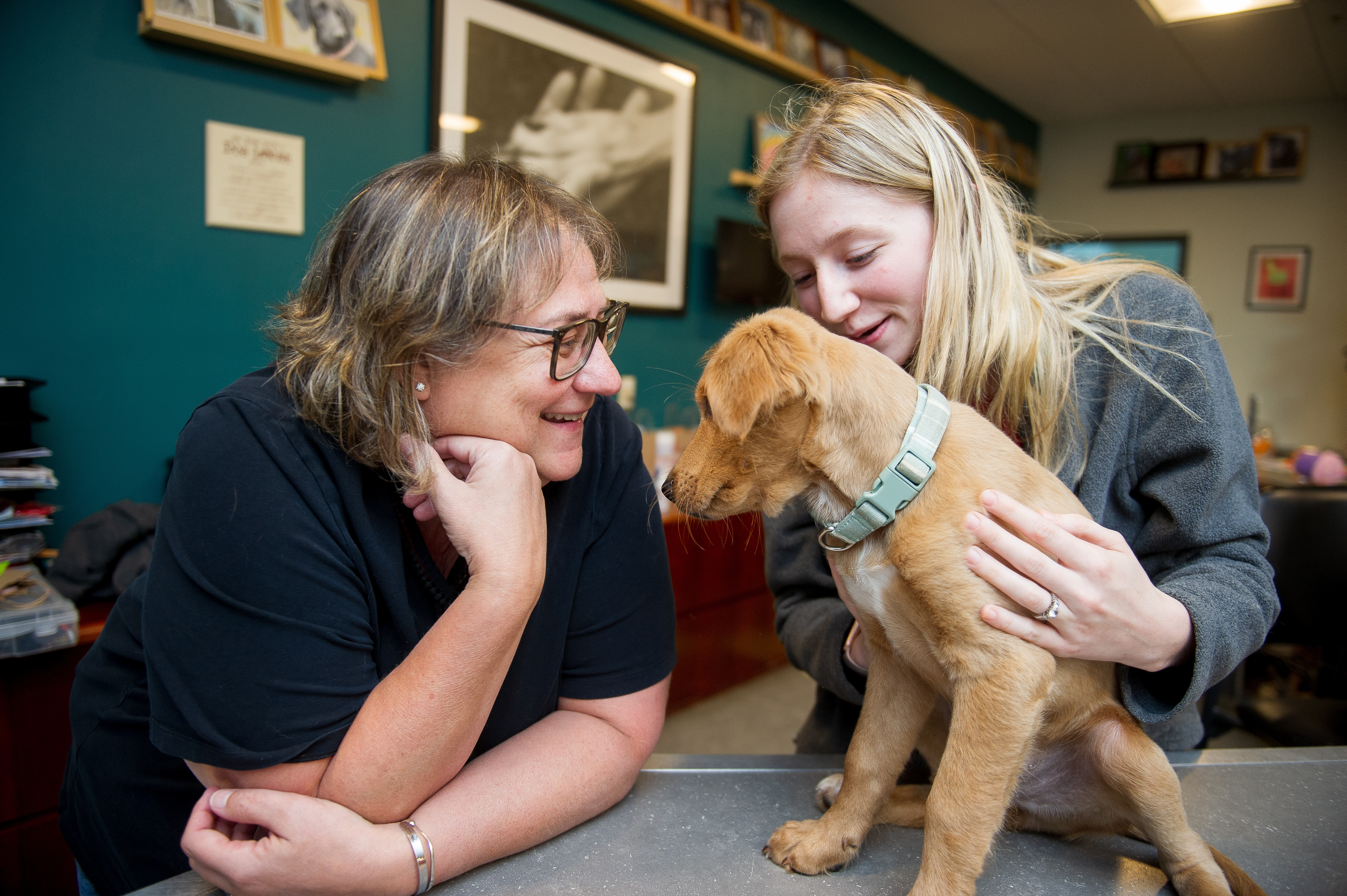
K9 Kaos owner Anne Nichols and Brittany Bonovich, employee and graduate of the animal science program, say hello to Beau, a regular of the shop. (Photo by Kate Brindley Photography)
Proctor also stresses the value of service. Part of the UNH Thompson School is time in areas where pets may not be able to receive a high level of care.
She will bring students to community centers or Pope Memorial Humane Society in Dover, the animal shelter that services Strafford County.
“Sometimes people can’t afford to give their pet proper care. Not everyone can afford high-end care, and I think the students should know that.”
A surprising but important component of the program is communication with pet owners. One of the PAWS rotations is answering the phone and scheduling appointments.
“Phone communication is a big part of what we do,” Proctor said. “Our industry tends to draw introverts who are attracted to animals. But working with people is vital. When an owner calls, it’s their first connection with the clinic, and it needs to be positive.”
Proctor adds that vet tech conversations aren’t always joyful.
“Sometimes the vet tech needs to give bad news to an owner. The students need to be prepared for that.”
Amber Meader agrees. Working at Winichahanat isn’t all about taking dogs for a walk and playing with them.
“It’s emotional. Sometimes euthanasia is a part of what we do here. When I was little, I had never thought of that when I decided I wanted to work with animals.”
“I talk about this with the students in their interview,” Dr. Hunt says. “That this is not all puppies and kittens. We see pets when they are sick or afraid. We try to comfort them, but we often do not see the pets at their best.”
Brooke Kruspki said that working at Winichahanat has changed her perspective on handling pets. “I’m seeing how different animals can react when they are sick. Pets can tell if you are anxious, and we all try to be calm.”
All of these on-the-job stories trace back to the program at Dover High. Animal science, along with all the high school CTE programs, has an advisory board, which is comprised of local business owners in that field. The CTE teachers meet with the advisory board twice a year to formally discuss trends in the business arena and how the school could address them in the curriculum.
Communication is one of the important skills that business owners want to see developed in future employees, along with maturity, professionalism and being able to own up to a mistake. The programs at both Dover High and UNH make sure to include those aspects of their programs.
Many business owners take on students from both programs because they know the students are ready to work and have solid experience. Nichols at K9 Kaos is a big supporter of the Dover High program, and like others is regularly in touch with both teachers.
“I talk to at least five employers a month and pass those opportunities on to the students,” Hough said.
Leah Pettingill and Gracy Bonyman are recent Dover High graduates who work at K9 Kaos. They both said they got job information from Hough. Pettingill speaks for all the Dover High animal science students about their jobs.
“It’s a real job. Not like the ones that most teenagers have. We get to work directly with animals. I love it.”