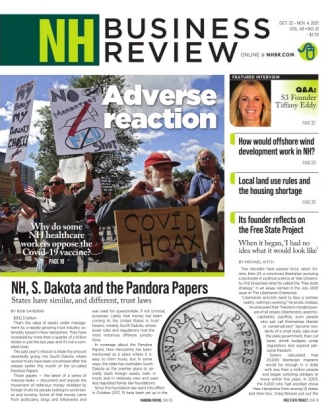
States have similar, and different, trust laws

$932.5 billion.
That’s the value of assets under management by a rapidly growing trust industry ostensibly based in New Hampshire. They have increased by more than a quarter of a trillion dollars in just the last year, and it’s not a complete total.
The past year’s infusion is triple the amount reportedly going into South Dakota, where several trusts have been scrutinized after the release earlier this month of the so-called Pandora Papers.
Those papers — the latest of a series of massive leaks — document and expose the movement of nefarious money shielded by foreign trusts by people looking to avoid taxes and scrutiny. Some of that money came from politicians, kings and billionaires and was used for questionable,
if not criminal, purposes. Lately, that money has been coming to the
United States in trust havens, notably South Dakota, whose loose rules
and regulations rival the most notorious offshore jurisdictions.
In
coverage about the Pandora Papers, New Hampshire has been mentioned as a
place where it is easy to form trusts, but in some ways, the state has
overtaken South Dakota as the premier place to secretly stash foreign
assets, both in trusts and in relatively new and even less regulated
family law foundations.
Since the foundation law went into effect in October 2017, 15 have been set up in the Granite State, six through LLCs created by attorney Todd Mayo, the trust lobbyist who authored that law.
“We’ve
gone ahead of South Dakota,” enthused Sen. Lou D’Alessandro,
D-Manchester, sponsor of much of the trust legislation since 2004,
though he quickly added that means “we’ve gone through all the hoops.”
Still,
most of the industry favors South Dakota. It has more than 100 trust
companies. New Hampshire has 40. While our trust law is updated
frequently and has bipartisan support, South Dakota’s is updated nearly
every year with recommendations from the Governor’s Task Force on Trust
Administration Review and Reform.
It has been a trust haven since 1983, and New Hampshire’s law was enacted in 2006, a
relative latecomer compared to other trust havens, like Alaska,
Delaware, Nevada and Wyoming. Florida and Texas are also getting into
the game.
And many of
these states — according to the website of the International Consortium
of Investigative Journalists (ICIJ), a nonprofit of 280 journalists
worldwide that received the Pandora Papers — show up in the Pandora
Papers. South Dakota has had 81 trusts involved, Florida 37, Delaware
35, Texas 24 and Nevada 14. New Hampshire? None, so far.
The
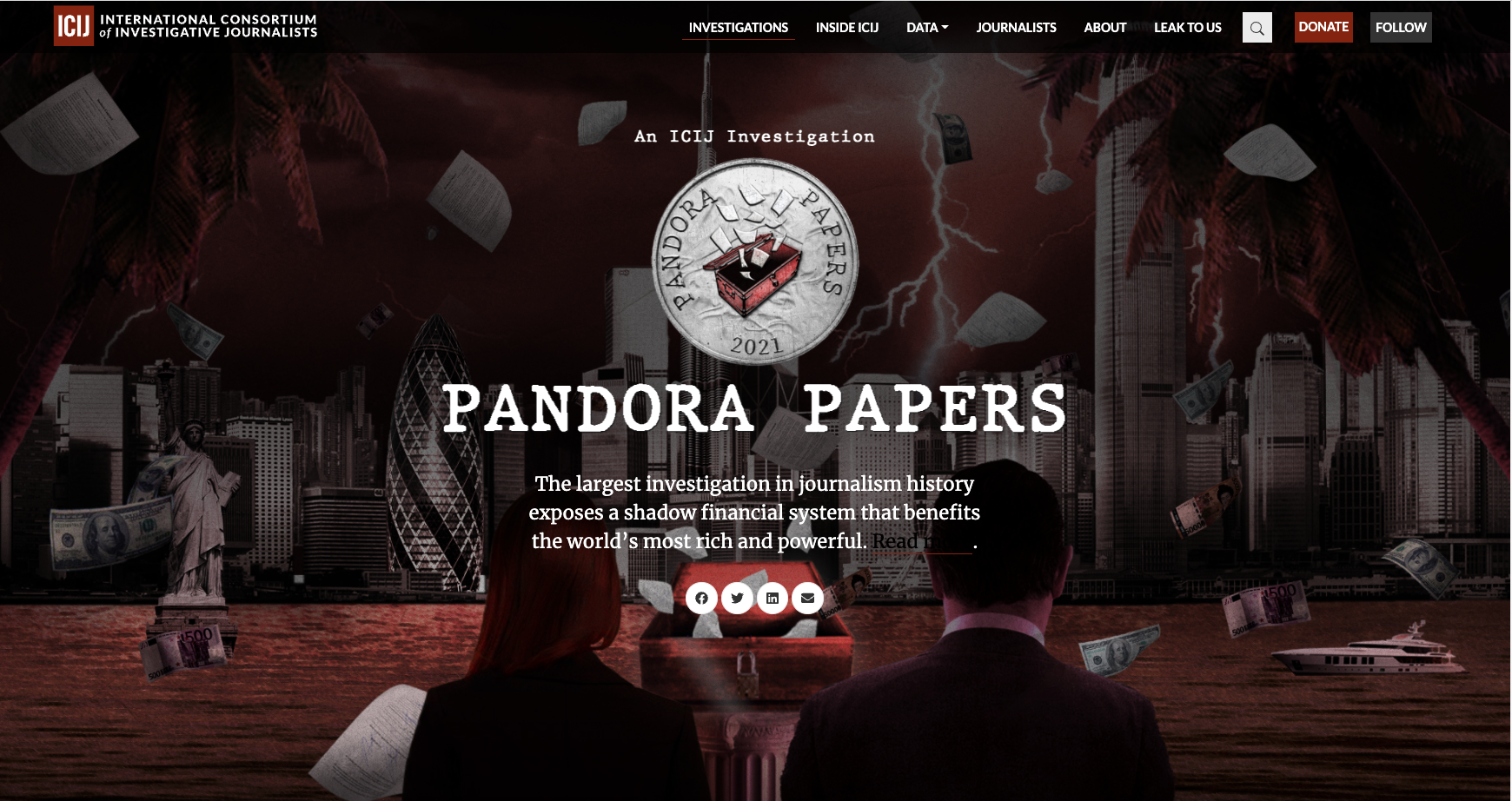
Pandora Papers, which have been pegged as the “largest investigation in
journalism history,” are based on the leak of nearly 12 million
financial records from 14 offshore service providers. They reveal the
secret offshore holdings of 130 billionaires around the world.
The Pandora Papers document the movement of nefarious money shielded by foreign trusts to avoid taxes and scrutiny.
It has led to scores of articles, with headlines like these:
“From
temples to offshore trusts, a hunt for Cambodia’s looted heritage”; “As
Catholic order fought sex abuse claims, secret trusts devoted to it
poured millions into American rental properties”; “Chilean President
Sebastián Piñera to be criminally investigated due to Pandora Papers
revelations.”
Trusts and trust companies
But
this is the tip of the iceberg. The Pandora Papers are a mess. They
include documents from so many different sources, in so many different
formats and languages, that only about 2 percent of them are so far
available on an accessible database shared with select journalists at
some 150 major news outlets. The organization is planning to share the
data with smaller outlets as well, eventually putting online its
database of at least 785,000 offshore companies, foundations and trusts
gathered from previous leaks, including the Panama Papers and the
Paradise Papers, which were leaked previously.
Those
older leaks, some with data dating back decades, contain 113 New
Hampshire addresses with some kind of offshore connection. On that
database, you can find Craig Benson, former governor and founder of
Cabletron Systems, as well as executives of various companies, like
Enterasys Systems, some of whom were charged with securities fraud,
Dennis Kozlowski, the disgraced Tyco International CEO who went to jail
for looting his company, and Paul Meister, who — along with Paul
Montrone (who is not in the database) — helped found Fisher Scientific
(now Thermo Fisher Scientific) and Perspecta Trust. Meister and Montrone
have been key figures in urging New Hampshire to become the trust haven
that it has become.
The list also includes
addresses at Dartmouth-Hitchcock Medical Center, Dartmouth College, St.
Paul’s School and a few prominent car dealerships.
Of course, a connection
with an offshore company does not constitute anything wrong going on. In
most cases, it’s just a legal way to shield legitimate family wealth
from taxation and prying eyes.
No
New Hampshire trust companies are in the database, though there are
some with similar names that could be their offshore counterparts, but
trust companies are not the trusts. They just administer the trusts —
trusts that are so secret we wouldn’t even know their names.
This
distinction between trust companies and trusts is often lost on the
public, said Bill Ardinger, an attorney at Concord-based Rath Young and
Pignatelli, another key figure of setting up the trust industry in the
state.
The state
Banking Department does know of the actual trusts and does examine them
once every three years, though a recent law gives them permission to do
it more often. Ardinger attributes the department’s high level of
regulatory scrutiny as one reason that trusts in New Hampshire have not
been caught up in the Pandora scandals.
South
Dakota and Nevada have “regulation light,” Ardinger said. “Those
involved in questionable stuff are not finding themselves in New
Hampshire. They go somewhere where oversight is not quite as excellent.”
But state Banking Commissioner Jerry Little is concerned about several aspects of New Hampshire’s trust law.
“If
we do find out something is going on here, it will probably be because
of the ICIJ,” he said, because “of the extreme amount of confidentiality
written into the state’s law.”
First, most trust companies chartered in New Hampshire don’t have a physical
presence. (South Dakota requires an office and a person to fill it.)
Some 21 of New Hampshire’s 34 public trust companies don’t even list a
New Hampshire location, and several that do have a New Hampshire mailing
address but no real presence here. This undercuts some of the
advantages of attracting the trust industry here, said Little. Without a
local nexus, the state won’t get a larger share of taxes, and “the
promise of new jobs has fallen flat. There are only a couple of hundred
jobs they could point to,” he said of the law’s proponents.
It’s
true, said Ardinger, that the trust companies themselves won’t generate
the thousands of jobs created by a financial giant like Fidelity
Investments. The job growth is more significant, though harder to
measure, for firms that play a supporting role. “Think of all the
supporting financial services: the law firms, the accounting, the
auditing firms,” said Ardinger.
He
points to Perspecta Trust, which was acquired in November by Jordan
Park Group, an investment management company in San Francisco without a
trust department or an eastern presence. The rebranded Jordan Park Trust
Company is now moving into new offices in Portsmouth and doubling its
workforce from 15 to 30, according to Glenn Perlow, a former New
Hampshire banking commissioner and the company’s general counsel. Those
additional jobs won’t all be in trusts, but they are jobs nonetheless.
The
lack of a physical presence is also a regulatory concern, said Little,
who pointed to Noble Trust, which went under in 2008 as part of a $20
million Ponzi scheme. The department ended up getting back half of that
loss to return to investors when the liquidation finally wound down in
June 2019. Back then, most of the documentation was on paper. Today, “we
have trust companies spread across the
globe, and everything is on the cloud. If we have another situation
morph into a criminal enterprise, it would be hard to contain,” Little
said.
Recently,
he said, when the Banking Department’s staff tried to examine a trust
company located in Massachusetts, they were told by the security guard
at the building that there was no such company. The company had moved
without informing the department. “That’s not OK,” said Little.
No actual oversight
The
state recently passed a law requiring trust companies and their
officers to provide physical locations, and that they have to travel to
New Hampshire, records in tow, for an examination. “We need to know
where they are operating. We need to know where to send a
cease-and-desist,” said Little.
Perlow,
who’s also president of the New Hampshire Trust Council, points to
these changes as evidence of how closely New Hampshire is regulated
compared to states like South Dakota. “They have access to our books and
records,” he said.
New
Hampshire is also a bit more transparent than South Dakota in other
ways. There, trust litigation is under seal. Here, it’s still public.
And New Hampshire has a “women and children provision” that permits a
court order to pierce the trust’s veil of secrecy. South Dakota doesn’t.
But
New Hampshire has caught up to South Dakota and others in another way —
unregulated family trust companies — and has exceeded them when it
comes to civil law foundations.
Family trusts involve beneficiaries that are of the same family as the founder. Family trust companies administer family trusts.
“If
I can’t get my brother to be the trust administrator, then I can go to a
corporation to do it,” said Ardinger. “Why have all these complex
regulations for that?”
Five
of the 40 trust companies in New Hampshire are unregulated. Their
assets are not part of the $932.2 billion worth of assets counted in New
Hampshire, since trust company assets and the very names of the
companies themselves are confidential.
South
Dakota already had unregulated family trusts, but they don’t have
foundations. Foundations are similar to trusts, but are based on civil
law as opposed to common law, and are usually found in Europe and Latin
America, but not in the United States. Or at least that was the case
until 2017, when the New Hampshire legislature passed the Foundation
Act. (Wyoming has since copied the law, and it will take effect there
next year, according to Perlow.) The idea is to attract wealthy
individuals and families around the world who are already comfortable
with such entities to set up shop here.
The
original legislation would have housed the foundations at the Banking
Department without giving it the power to examine them. Little said he
wanted no part of that, so the oversight landed at the Secretary of
State’s office, registered like any other company but with no actual
oversight.
Todd Mayo, a
former general counsel of Perspecta, wrote the Foundation Act, and a
Bow company he set up — Vanderwal Martens LLC — is now an officer for
six of 15 foundations. Two years ago, Mayo became the senior wealth
strategist at UBS out of New Jersey and changed registration over to
Madeleine Blanz, sometimes known as Madeleine Blanz-Mayo, at the same
address.

Calls to Mayo at UBS and emails to Vanderwal Martens LLC were not returned at deadline.
In
five of the six cases, a director of the foundations is Aver Associates
LLC, an independent “multifamily office” that started in Luxembourg in
1997, but whose head office is based in Malta. Aver also has an office
on Wall Street in New York City, which is the listed address on the New
Hampshire registration.
Aver
Associates consists of two people, Koen Maria J. Lozie of Malta and
Justyna Marta of Gdansk in Poland. Both names pop up occasionally in the
ICIJ offshore leaks database.
Three
other foundations all give the same address in Obarrio, Panama. One,
the Patillal Foundation, uses a lawyer based in Bogotá, Colombia.
Another, the Polaras International Foundation, has a director: Herschel
Alonso, president of Coron Energy SA, a Panama company. Marzell Beck of
Liechtenstein is the organizer and director of the Laramie Foundation.
Beck, a lawyer, was listed as president of the state court there two
years ago.
“Just
because a company is in another country doesn’t mean it’s not capable
of behaving responsibly,” said Perlow. “New Hampshire has done whatever
we have had to do to see that we don’t have the kind of bad actors in
South Dakota.”
But
Little isn’t so sure. And both say they’d rather not see New Hampshire
trusts or foundations featured in a future Pandora Papers-inspired
investigation.
Bob Sanders can be reached at bsanders@nhbr.com.