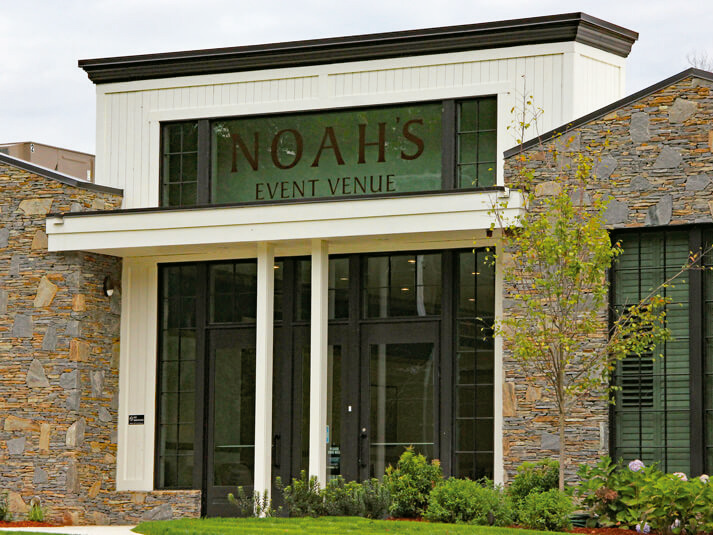
Event venue firm at center of ‘scam’ investment deals
For Nina Johannessen, a 62-year-old web designer in Littleton, financial losses from her investment in what was described as the “Home Depot of wedding venues” were in the six figures, and the biggest loss was her future retirement.
When she found out she only owned a small piece of an undeveloped plot of land in Jacksonville, Fla., “I was kicking myself, my stomach sank. What a fool I was,” she said.
Her investment was made through Edmund & Wheeler, which is based in Franconia, as was one made by Anson Smith, a retiree nearing 80 in the town of Grafton. He lost $150,000 on the same property. “They frittered away all my money before they got a shovel in the ground.”
Steven LaRoza — a 56-yearold part-time stuntman living in Whitefield — sold his California construction company to live off the proceeds through his $1.4 million investment in four properties via Edmund & Wheeler, because they were “just down the block, because I trusted them. Now, I’m working again, because of this,” he said.
“This” was the double bankruptcy of Noah Corporation and its property arm, Rockwell TIC (Tenants In Common). Both companies are based in Utah. One of Noah’s 32 wedding and event venues was in New Hampshire (in Bedford), but a disproportionate number of the creditors, and litigants, are from the Granite State.
Some 72 creditors are from the Granite State, including state Rep. Judith Spang, D-Durham, and of the 71 plaintiffs, nine are from New Hampshire — including Ed Hennessey, former chief financial officer and general manager of Littleton Coin Company, who retired in 2018. Another 14 litigants are from neighboring states.
New Hampshire’s unexpected connection to this whole affair is primarily due to John Hamrick, the head of Edmund & Wheeler, which recommended many of his clients, friends and family to invest in such properties.
Hamrick is a qualified intermediary, or QI.
QIs are largely unregulated, but they are required if you want to use a 1031 exchange, which allows people selling commercial properties to avoid federal capital gains taxes by buying similar valued properties within a short time period. EWI is one of the oldest and largest independent qualified intermediaries in the region, if not the nation.
Noah Corporation and Rockwell Dept Free Property (the official name in the bankruptcy filing) filed for bankruptcy in 2019 with liabilities totaling $130 million. The companies — and a number of other companies and individuals working with and for them — are targets of two ongoing federal lawsuits in Utah claiming that they were a fraudulent scheme. The Securities and Exchange Commission filed and settled security fraud charges against four principals in the companies as well.
But Edmund & Wheeler, and Hamrick and some of his fellow staff, were also targeted in those suits, as well as two others — one in New Hampshire and one in Vermont — and they are the subject of an open investigation by New Hampshire’s Securities Division.
Hamrick said that the suits — one of which he settled — will go nowhere, because “they have no case. I got fed a bill of goods, just as much of my clients have.”
Hamrick claims that he had little to do with Noah directly, and he had no reason to suspect Rockwell, which has been a good client for decades. Indeed, he said he himself invested in two Rockwell/Noah properties, including the one in Bedford, and lost $700,000. He contends he found out about Rockwell’s dire financials just when everybody else did, shortly before Noah stopped paying rent to Rockwell in early 2019.
“I’m the worst victim of anyone,” he told NH Business Review, not just because he lost money, but because “I’m petrified I’m going to lose the way I make a living, that I’m being tarnished. And equally upset about my clients. My heart bleeds for these people.”
‘Inflated returns’
The lawsuits cast Hamrick in the role of a villain. They charge that his company knew, or should have known, that Noah Corporation was a national Ponzi scheme unraveling for years. Yet they kept selling the same story: a company that was booming, a surefire investment, paying large rents on property even before they were built. But in reality, instead of going to construct new event venues that would generate the real income, the investors’ money would be used to pay their rent and the rent of former investors on other unbuilt or partially built properties. Funds were commingled and millions of dollars disappeared. Some went into the pockets or projects of the company’s owners and their family, but some also went into secret commissions — plaintiffs called them kickbacks — of the QIs who steered people into the properties.
In some of the suits, Hamrick was not only charged with securities fraud, conversion and deceptive practices but with elder abuse.
“The whole thing was a scam,” said Wesley Felix, an attorney, in a suit filed by 18 plaintiffs in Utah in April 2019. “They suckered people in with these inflated returns.”
The Noah’s event venue in Bedford, which was closed in January 2020.
He said the QIs knew the property didn’t support this, but they got their 3% to 6% off the top. They preyed on the elderly. A lot of people lost their retirement.”
Hamrick was one of Rockwell’s biggest referral sources and conferred with Rockwell officials at least twice a year at the annual February marketing and strategy event in Arizona and at Rockwell’s Christmas party, according to the suit.
“Hamrick, Bowser and the Rockwell defendants were active participants in the creation of marketing materials and marketing strategies and were all involved in strategic planning of how to run the real estate holdings,” it charges.
“It seemed as if he was running the show,” said Kathleen Lopez of a 2016 meeting discussing how her agency — Sentinel Sales and Management, also in Utah — handled the properties that Hamrick had referred to. Hamrick would “dictate” operational matters and even the agency fees, she said, and Rockwell wanted her to please Hamrick because he was such a large source of investors.
“Of course I knew people at Rockwell. I’ve worked with that company for 11 years,” said Hamrick.
As for Lopez, she was an “instigator” who didn’t report delinquent rent for a year and a half. “We had to have an attorney to make her quit saying disparaging things.”
Noah sued Lopez for libel and she countersued, and both suits were dropped following the bankruptcy filings, Lopez said.
Lopez said she reported the delinquent rents as soon as she was aware of them and turned all her documents over to the SEC. She described herself as a whistleblower and said there has been a retaliation campaign that has caused her to lose business.
Tenant in common arrangements
The SEC complaint didn’t charge Hamrick, but it did allege that William “Bill” Bowser, former president of Noah, as well as Christopher Ashby, Scott Beynon and Jordan Nelson, founders and owners of Rockwell, defrauded 90 investors who purchased $35.9 million in securities between January 2017 and 2019.
Rockwell knew Noah was losing millions of dollars dating back to 2014, yet it continued to purchase land, according to the complaint. Its construction arm, Gabriel Management, would start drawing down a fifth of its fee sometimes before the land was even purchased, the complaint adds.
Although both companies maintain that the tenant in common arrangements, where investors would theoretically buy a slice of the property, were real estate transactions, the SEC ruled that they were securities contracts and also charged the four with unregistered sales of securities.
At the end of 2020, all of the defendants settled, agreeing to more than $2 million. While the final judgement starts off saying that they agreed to do this “without admitting or denying the allegations” it adds, for the purposes of the bankruptcy court, “the allegations of the complaint are true and admitted.”
The New Hampshire Securities Division started investigating the matter as well, according to LaRoza, who was questioned by the SEC in April 2019, and the division in July 2019.
Hamrick, too, said he was questioned by both agencies, but understood that he was dropped from both investigations. The SEC did not respond to inquiries. Jeff Spill, deputy director of the Securities Division, said he could not comment because it was still an open investigation.
LaRoza was one of the plaintiffs in that first lawsuit, which focused on one property in Carmel, Ind., that Rockwell purchased for $654,740 on June 27. But Rockwell already had sold the tenant in common interests to Ed Hennessey and Russell Hertrich, another New Hampshire plaintiff, thought they were told the sales happened in July and August, according to the complaint. After Rockwell sold the rest of the shares, it got a total of $6.2 million.
The marketing materials included 20 interior and exterior photos of an existing building, which the suit said was “misleading.”
“Hamrick, in particular, who is a self-professed expert 1031 Qualified Intermediary, knew that the Carmel property was not built and that it could not be built within the 180-day time frame required for 1031 exchanges,” charges the suit.
LaRoza said he knew Hamrick through Mary O’Toole, Hamrick’s life partner as well a partner in Edmund & Wheeler and owner of her own real estate firm, O’Toole Enterprise, LLC. O’Toole also had a dog-walking service and walked LaRoza’s dog.
“We thought this was going to be a great property, blah blah blah,” he said. After being promised an 8% return, he bought in twice, in September and once in December. Although he said that Hamrick told him the property was almost complete, when he checked on dated Google maps, “it wasn’t there.” Another property he was investing in wasn’t there as well, but “we just kept getting rent, until we didn’t.”
When in March 2019, he learned what was going on, he said. “I just couldn’t believe it. They should all be in jail. It’s just incredible.”
Hamrick’s lawyers filed a motion in 2019 to dismiss the case, saying their client was just “caught in the middle of this financial nightmare … The E&W defendants had no knowledge of, and did not participate in, any conspiracy.”
Later, the motion added, “A far more plausible explanation is that Hamrick did not know, and could not have predicted, that Noah’s Carmel would not be constructed, and that he learned the truth at the same time the plaintiffs learned it from Bowser in late March 2019.”
More lawsuits
Edmund & Wheeler, Hamrick and an employee, Chris Brown, were dismissed from the case in November 2020 as part of a settlement, the terms of which neither side would disclose. LaRoza said he got about $20,000 from settlements. The Rockwell plaintiffs settled in February 2021 as well, leaving only Bowser and First American Title Insurance as the main defendants.
Edmund & Wheeler, Hamrick, Brown and O’Toole and O’Toole Enterprises are defendants in another Utah suit filed January 2020. It echoes many of the Ponzi scheme allegations in the first, but includes four unbuilt properties and 51 plaintiffs claiming $20 million of losses, including Nina Johannessen, who is a client of Hamrick, and Anson and Genevieve Smith, a client of Brown.
“I was tied up in real estate and I was trying to avoid some big tax whacks,” said Anson Smith. “Hamrick seemed like a nice guy, and Chris was particularly high on Noah.”
But, he added, “they didn’t show you a monthly statement. Just a check. They didn’t give you too much of an accounting.”
Johannessen was looking to invest the proceeds from the sale of a house
to settle in Littleton in a tax-deferred like-kind exchange.
“They came across as affable guys, but there was a lot of pressure,” she said. “The company (Noah) was flush with cash, it’s under construction, if I bought in July it would be done in January. It turns out they didn’t even have a permit. The money just disappeared.”
“Hamrick knew from his long and close relationship with Rockwell and Noah that Noah had failed to make tax payments, complete buildings on time and pay its debts as they came due, and therefore knew that representations about Noah and the safety and suitability of investment in a Noah TIC Property were false,” says the 2020 complaint.
Oak Hill Management, a group of investors in Vermont, are also part of that suit, but they chose to sue Edmund & Wheeler, Hamrick, O’Toole Enterprises and O’Toole separately in Vermont, “for an egregious fraudulent real estate scheme to persuade investors to invest millions of dollars into a failing business under the facade of deferring capital gains taxes.”
The suit says Edmund & Wheeler steered them away from other properties to secure replacement properties to satisfy the 1031 exchange. Oak Hill ended with a $3.55 million 48% investment in a property that was purchased for $630,000 in Toledo, Ohio.
Oak Hill also sued McLane Middleton, the Manchester law firm, and John G. Burke and Associates, a Keene accounting firm, who represented Oak Hill, for not doing enough due diligence to uncover the scam.
Construction of the Toledo facility got as far as an outer shell, but that creates another problem. The contractors who worked on it have a lien on the property and have sued for more than $240,000.
In the 2020 suit, Edmund & Wheeler again ask that both Hamrick and O’Toole be dismissed from the case. “Hamrick did not know, and could not have predicted, that the building would not be constructed,” his attorney argued. And O’Toole, who handled backroom operations, had even less knowledge. On Aug. 27, a Vermont judge granted the O’Toole dismissal but denied the motion on Hamrick.
A New Hampshire suit filed July 27 by Homes Development Corp. of Burlington, Mass., is just the latest claiming that Hamrick lured its client into Noah’s Ponzi scheme.
“They say ‘Ponzi scheme’ for dramatic effect,” said Hamrick. “There is no proof or evidence that I knew anything about what happened in Noah, but they see the words ‘Ponzi scheme’ and my name, and I’m done.”
The SEC didn’t charge him, he said, and as further proof, when the bankruptcy trustee referred the matter to the Department of Justice, they didn’t bring criminal charges against him or anybody else.
“I’m cleared,” he said, “but I’m being tried in the court of public opinion.”
In the last public hearing on the Noah Bankruptcy, trustee Philip G. Jones concluded that it seemed unlikely the estate would be able to bring in enough money to go after individuals to be worth the expense. Jones said he didn’t refer the matter to the SEC or the U.S. Attorney’s office, but he did bring it to the U.S. Trustee Program (part of the Department of Justice) in Utah.
“This gives me great grief to the injustice that has happened,” said Barbara Smith, an accountant who worked on that report. “Someone needs to take this bull by the horns to make sure something is done. He (Bowser) created somewhat of a Ponzi scheme … To just leave the creditors holding the bag, I think it’s a mockery of the system. It’s a tragic situation to see it get transferred over and nothing happen.”
An inquiry to the Trustee’s Program was not answered by deadline.
Bob Sanders can be reached at bsanders@nhbr.com.
‘They preyed on the elderly. A lot of people lost their retirement.’