Lakes Region Community Developers Executive Director
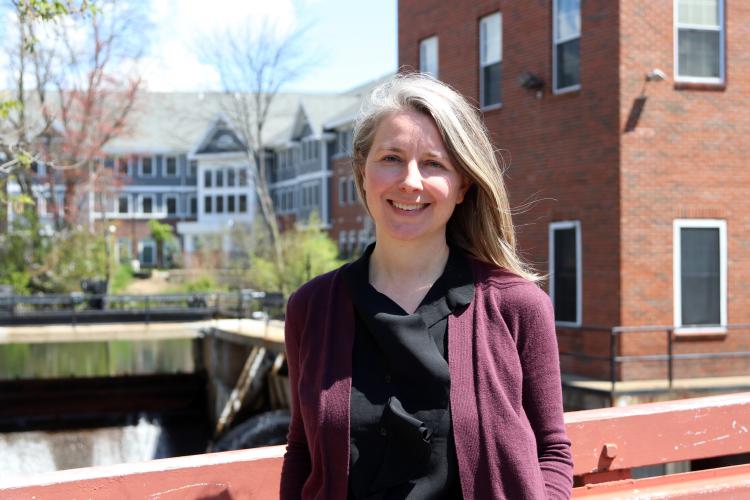
Carmen Lorentz
‘The
difficulties that first-time buyers face has nothing to do with
unrealistic expectations. It’s simple economics – supply and demand,’
says Carmen Lorentz of Lakes Region Community Developers. (Photo by Allegra Boverman)
Carmen Lorentz is executive director of Lakes Region Community Developers, a housing and community development nonprofit based in Laconia with a $60 million portfolio of affordable rental housing.
She started the job in 2017, after serving as director of the state’s Division of Economic Development.
Under her leadership, the organization has been diversifying its real estate development activities to include developing affordable starter homes, supportive housing and affordable commercial space for local nonprofits serving critical needs in the region.
Q. How has the
shrinking inventory and rising cost of housing affected Lakes Region
Community Developers’ capacity to maintain and develop its portfolio of
properties priced within the means of working families?
A. We
have 366 apartments in six different towns. Our vacancy rates are the
lowest they have ever been, and during Covid-19, turnover has been much
lower than normal. This helps us maintain our portfolio. So, low vacancy
and low turnover is good from the perspective of operating our
properties.
When it
comes to developing new housing, the tighter market makes it more
difficult to find a site that is the right size, has all the
infrastructure we need and that is affordable. When you’re developing a
rental project, you know how much acquisition cost per unit your project
can accommodate. Most of the time, there is very little wiggle room.
Q. What
challenges has the agency encountered in its efforts to diversify its
portfolio by developing starter homes? Do first-time homebuyers expect
more of a starter home than its cost can provide?
A. The difficulties that first-time buyers face has nothing to do with unrealistic expectations.
It’s
simple economics — supply and demand. Freddie Mac estimates that we
need 3.8 million more housing units nationwide. New Hampshire Housing
Finance Authority estimates we need 20,000 more housing units in New
Hampshire. We are in a huge hole, and the only way out is to build more
entry-level homes. In order to do that, we need public investments in
water and sewer infrastructure and changes in zoning to allow
higher-density development in appropriate areas.
Without
those two pieces, it’s difficult, if not impossible, for developers to
build entry-level homes that people who live and work here can afford.
We
have been working on a development of 20 entry-level homes in Wolfeboro
for a few years. We hope to break ground this summer. The only reason
we even attempted this project in Wolfeboro is due to our strong
partnership with Eastern Lakes Region Housing Coalition, which owns the
land and is selling it to us for a very low price. We also secured
$540,000 in state and federal grant funding to help offset the cost of
the road, water and sewer infrastructure. We really could use more
subsidy on the infrastructure, but there are no funding sources for this
in New Hampshire.
Q. How should housing policies balance meeting the needs of an aging population with ensuring the growth of a younger workforce?
A. The myth that
workforce housing creates a burden on elderly homeowners has been
debunked, and we need to move past it. As a landlord, we pay property
taxes on all our properties. We pay $350,000 in property taxes every
year — $150,000 per year just to the City of Laconia! Our tenants are a
diverse mix of single people, couples with no kids, families with
children and elderly people. When you average it all out, our tenants
pay for the public services they use and do not create a burden on
elderly homeowners.
An
aging population needs young workers. Young workers need housing they
can afford. If we don’t build housing for young workers, our aging
population will find it more and more difficult to access the services
they need to thrive.
Q. How does the high proportion of seasonal homes in the Lakes Region weigh on the supply of affordable housing in the region?
A. For many people, a
second home can be smaller than their primary residence, and it doesn’t
need to be on the water. This is exactly what most first-time buyers
can afford. So there is direct competition between first-time buyers and
secondhome buyers. Most of the time, the second-home buyer with higher
net assets and more cash is going to get the house.
Many
second homes are used as shortterm rentals now, making even more homes
unattainable for local first-time buyers. This keeps first-time buyers
in the rental market longer, which puts increased pressure on the supply
of rental units, making it harder for year-round renters to find a
place they can afford.
We
have this very strange situation where we’ve got lots of empty houses
and condos and lots of local people who can’t find anywhere to live.
This is one reason we need to build more workforce housing and
entry-level homes that are incomerestricted.