As families struggle through pandemic, some lead the way in broadening access
Since
the pandemic, 52% of parents say that it’s been difficult to handle
childcare responsibilities, up from just 38% pre-pandemic, according to
the Pew Research Center. The same study found that 65% of parents who
work at home are caring for their kids while they work. When schools
closed for in-person learning, many parents lost a critical part of
their childcare plan. (Photo by Aaron Lipsky, courtesy of the Keene Sentinel)
A year ago, most working
parents — particularly mothers — would have said that it was difficult
to balance the demands of home life and work. That was before the pandemic hit, shutting down schools and day cares, disrupting routines and forcing more than 1 million people from the workforce in September alone.
Most of the people who left the workforce were women, who were twice as likely as men to blame their departure on lack of child care.
The pandemic has exacerbated existing challenges for working families, and also opened up new discussions about the public policies that might alleviate their burden.
“It’s unfortunate that it takes a pandemic to get us talking about women’s roles in caregiving, how to assist caregivers and workers,” said Kristin Smith, visiting associate professor of sociology at Dartmouth College, who studies labor markets and work and family policy. “The pandemic is making this a much more talked about issue than it has been in the past.”
While these challenges affect most families, they have a disproportionate impact on families of color. Nationally, families of color are more likely to experience child care-related job disruptions that impact their finances and are less likely to have access to and use paid family and medical leave. There is no data specific to the experience of people of color in New Hampshire with regards to these issues, Smith said, adding that she imagines the national trends would hold true.
Smith and other experts say that instituting public policies, including paid sick leave, paid family leave and strengthening child care, would help alleviate the burdens that working families face.
‘Biggest emergency’
Since the pandemic, 52% of parents say that it’s been difficult to handle child care responsibilities, up from just 38% before the pandemic, according to the Pew Research Center. The same study found that 65% of parents who work at home
are caring for their kids while they work. When schools closed for
in-person learning, many parents lost a critical part of their child
care plan.
The pandemic has highlighted how frail the child care infrastructure is in the United States.
The current
each-family-for-themselves model is built on the historical premise that
women will provide unpaid child care, said Jess Carson, a research
assistant professor of public policy at the University of New
Hampshire’s Carsey School of Public Policy. But with 72% of mothers
employed, the child care system needs to catch up.
“It’s our biggest emergency in the pandemic, and it was the biggest emergency before the pandemic,” said Carson.
The child care industry suffers from a dual problem: the high cost of care and the low pay for workers.
“Parents are paying too much, and providers are paid too little,” said Carson.
The
federal government defines affordable child care as that which takes up
7% or less of a family’s income. But in the Granite State, where a year
of full-time infant care costs $12,971, child care takes up more than
15.3% of the median family’s income, according to the Economic Policy
Institute. For child care workers — who often are paid low wages —
having one infant in full-time care would take up more than half of
their pay.
From a
business standpoint, child care doesn’t make sense, Carson said. The
cost of providing care is high, while there’s a cap on how much families
are able to pay.
“The
math just doesn’t work out,” she said. She said the U.S. needs policies
that reframe child care as a public good, like public education. There
are no expectations that each parent pays for their child’s schooling,
and it’s not feasible to expect parents to shoulder the burden of child
care, she said.
A nearby solution
One
of the leaders in child care policy nationally is nearby Vermont. In
2010, the state established Building Bright Futures, an organization
that brings together private and public players in the child care space
to establish an integrated child care system.
According
to Melissa Riegel-Garrett, Vermont’s Child Development Division policy
director, two aspects of the system in particular make the state stand
out: The state’s Child Care Financial Assistance program, funded by
state money in addition to federal dollars, ensures that all families
who need child care can afford it. The program is well funded, so there
is no waitlist for families receiving a subsidy to access child care,
Riegel-Garrett said.
Then,
there’s the state’s universal pre-kindergarten program, which started
in 2015 and gives all children between 3 and 5 access to 10 hours of
child care each week.
“There’s
been years of work by advocates in the private and public sectors to
educate policymakers, but also Vermonters in general, about the
importance of early years and the connection between child care and the
economy,” said Riegel-Garrett. “That work has come to a tipping point in
the past few years.”
Although
Riegel-Garrett couldn’t point to data on the impact of the child care
initiative on the economy, she said that anecdotally the link is clear,
especially since the pandemic.
To
prop up the system, Vermont allocated more than $40 million in funds to
the child care system. Programs included funding for emergency child
care, funds to help providers reopen and a one-time payment of $938 to
child care workers. (New Hampshire implemented hazard pay for first
responders, including firefighters and police officers, but did not
offer similar pay to other essential workers, including day care
providers and healthcare workers.)
Riegel-Garrett
said that Vermont is in the process of infusing another $12 million
from federal funds from the second stimulus bill into the child care
economy.
Lisa Ventriss
is president of the Vermont Business Roundtable, an organization of 125
CEOs working toward public policy initiatives in the state. She said
that after years of education about the economic impact of investing in
child care, the business community broadly supports expanded access to
it.
“The question, ‘Is
this a worthy place to invest?’ has been addressed and answered. The
business community says, ‘Yes,’” Ventriss said.
Making child care accessible isn’t cheap — Vermont spent more than $47 million in 2018 on the subsidy program
alone. The Vermont legislature is currently addressing the need for
additional, sustainable funding as part of House Bill 171.
“Vermont
is finally at this place where we are worrying about the funding, not
whether this is a worthy investment,” Ventriss said.
A
2017 report by the Vermont Business Roundtable found that for every $1
invested in child care, the state economy gains a $3.08 return. National
research indicates that society earns more than $7 return for every $1
spent on early childhood education.
“Employers are seeing that this is part of our economic recovery,” said Ventriss.
Still, the upfront cost of accessible child care on the state or federal level is daunting.
“People aren’t always willing to make investments in things that have payoffs down the line,” Carson said.
Paid family leave
One support for families that is making more progress is paid family leave.
Last
March, the New Hampshire legislature passed a bill that would create a
paid family leave program in the state, but Gov. Chris Sununu vetoed it
in July. He vetoed a similar bill in 2019, saying that requiring
employees to pay 0.5% of their wages into the plan would amount to an
income tax.
He
introduced his own paid leave proposal that would provide state workers
with six weeks of paid leave financed entirely by the state and allow
private-sector workers and businesses to opt in to the program if they
choose. Last year, the governor’s preferred bill, Senate Bill 730, died
in the chamber. Sununu has incorporated the plan into his budget
proposal this year, and it is currently making its way through the
legislative process, said Ben Vihstadt, the governor’s spokesperson.
There’s
also discussion about creating a paid family leave program at the
federal level. Currently, the Family and Medical Leave Act, passed in
1993, provides job protection and unpaid leave for qualified workers who
need to take time off to care for themselves or their family members.
“That was envisioned as a first step, and the second step (of paid leave) would follow shortly, but here we are,” said Smith.
The
pandemic has exacerbated existing challenges for working families and
also opened up new discussions about the public policies that might
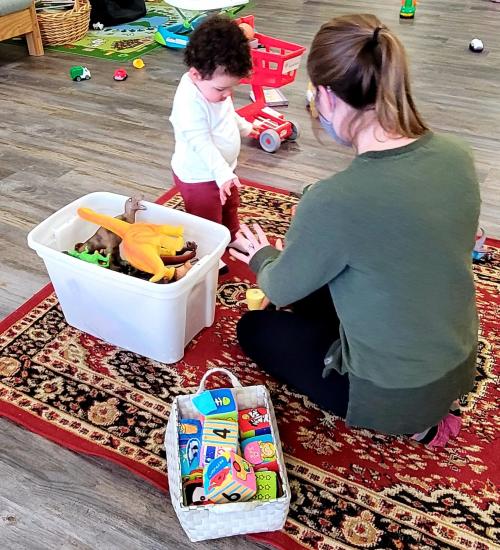
alleviate their burden. A mom and toddler participate in a pod playgroup
at Thrive Family Resources in Hooksett. (Courtesy photo)
Despite
federal inaction so far, states are making progress on the issue. Nine
states and Washington, D.C., have enacted paid family leave programs.
California was the first state to enact paid leave in 2002, with New
Jersey following suit in 2008.
“Other
states that are looking at this as a solution can learn from the
mistakes that New Jersey and other states have made, and what they’ve
learned along the way,” said Debra Lancaster, executive director of the
Center for Women and Work at Rutgers University in New Brunswick, New
Jersey.
One of the
most important parts of any paid family leave program is the level of
reimbursement. The New Jersey plan — which is funded entirely by worker
contributions — replaces 85% of an individual’s weekly income, with a
cap in place for high earners. If a reimbursement rate is too low, the
plan doesn’t work for lower-paid workers, because the amount they
receive isn’t enough to subsist on. Paid leave plans need to reimburse
at least 60% to 65% of an earner’s wages to be useful, Smith said.
Higher reimbursement rates also help promote more fathers taking
leave. In 83% of heterosexual families where both parents work, the
father makes more than the mother.
Often that means families are unable to have the father take leave if it is not well funded, Lancaster said.
“We want to make sure the wage replacement programs address the whole household’s wages,” she said.
Research from New Jersey and other states with paid leave programs has shown the economic benefits.
In
both California and New Jersey, paid leave has been associated with
more workforce engagement by women, particularly those without degrees
who generally earn less.
In
states with paid leave, fathers are more likely to take time off at the
birth of a child and mothers take longer leave. In addition, women with
access to state leave are less likely to utilize public benefits after
the birth of a child, Lancaster said.
There are also health benefits, including lower risk of depression for mothers and higher breastfeeding rates.
According to the Center for American Progress, the economic benefits of paid family leave are:
•
Increases labor force participation, lifetime earnings and retirement
savings, particularly among women, thus reducing reliance on public
benefits.
• Increases employee retention, lowering costs for employers and increasing businesses’ value in some cases.
• Improved outcomes in early childhood, having intergenerational effect.
The
Carsey School’s Carson points to research that found that a $3,000
increase in a family’s income is associated with 17% increased earnings
for children as adults — a boost to the economy long term.
Lancaster
points out that paid family leave isn’t just for people who are growing
their family. Most programs allow employees to take time off to care
for a sick parent, partner or child, or to attend to their own medical
issues.
“People in all walks of life need to care for a loved one at some point,” she said.
But,
although the New Jersey plan has been active for more than 10 years,
many people still aren’t aware that they can utilize paid leave,
Lancaster said. Those who know about the plan — especially people in
male-dominated sectors — often hesitate to take the leave they’re
entitled to. That’s the next barrier that Lancaster would like to see
her state address.

“The challenge is really in creating a culture in which taking leave is supported and encouraged,” she said.
Meanwhile,
the pandemic prompted the state and federal governments to take action
to support workers, with stimulus payments, expanded unemployment and
limited paid sick leave.
“Covid
has been a testing ground for a lot of efforts that we may not have
tested otherwise,” she said. “It’s a good time to take the lessons
learned from that and push forward in the years to come.”
While
tackling issues like work-life balance and equitable access to child
care can seem daunting, there are solutions, Smith added.
“We know what we need to do. We just have to have the political will to do it.”
This article is being shared by partners in the Granite State News Collaborative. For more information, visit collaborativenh.org.