But wage theft is rare in the state, review of cases finds
It wasn’t an easy time two years ago, when Terri McGuinness was running around the state setting up pop-up bars and mixing drinks at weddings and other events for Pour Me Bartending, a Manchester firm. She also was working at another bar and a medical assistance company, and she was studying for her real estate brokers’ license.
“It was a little crazy.
I was trying to juggle a lot of jobs to make ends meet.
Every dollar counted,” McGuinness, who is now an agent for Verani Realty in Londonderry.
Pour Me Bartending paid her about $10 an hour, but she hoped to make
more with tips. A 10% gratuity was included in the contract with
clients, “but I was wondering why I didn’t get the tips.” After she and
other employees asked about it, she got a text message from the company:
“I wanted to just touch base and let everyone know that under NO
circumstances, if the client added tips, would I not pay it out to you.”
But
the tips — and the wages for two events — never came, ruled the New
Hampshire Department of Labor on Feb. 28, 2020. The company did not
reply to the complaint in writing or show up to a scheduled hearing, or
reply to NH Business Review’s email. (Its website is down, and there is
no answer at its phone service.) The DOL awarded McGuiness $2,145 and a
total of $5,360 to four other employees, but she hasn’t been able to
collect the money.
Fortunately, McGuinness’ case is the exception not the rule in New Hampshire, even when it comes to labor violations.
Wage theft might be a national problem. According to an Economic Policy Institute study, in the nation’s 10 most populous
states, an estimated 2.4 million people lose a combined $8 billion in
income every year due to theft by their employers.
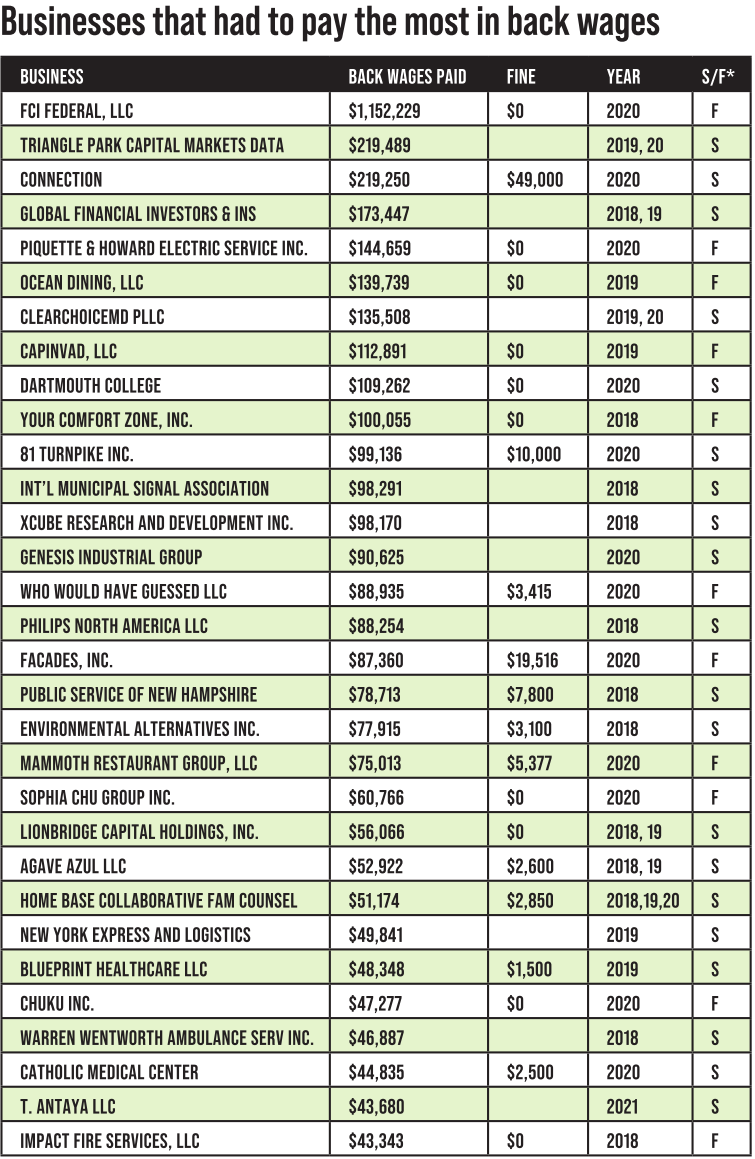
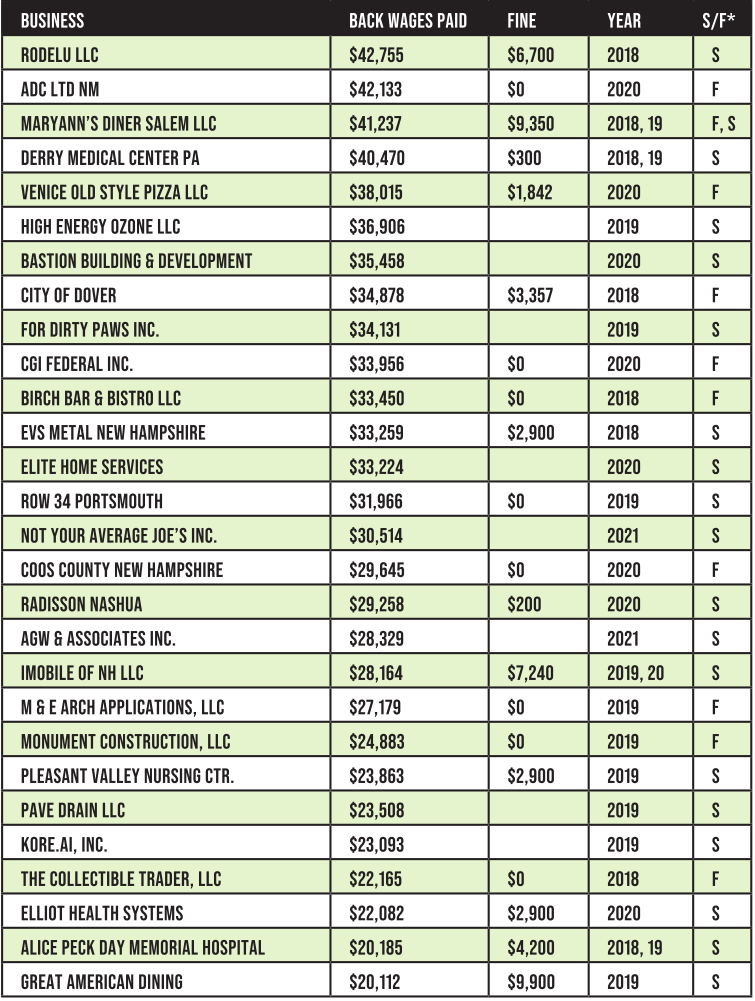
*State or Federal Department of Labor
Source: Federal DOL https://enforcedata.dol.gov/views/searchChooser.php
State
DOL data from 2018 to first quarter 2021 provided to NH Business
Review. Different rulings are totaled together. Back wages include wage
adjustments and wage claim rulings. In
New Hampshire over the last three years, the federal and state Labor
Departments ordered companies to pay their workers about $7 million, ($4
million through the state and $3 million through the federal
government). Both agencies issued a total of about $1.8 million in civil
penalties to employers as well during the period.
But,
at least in the case of state complaints, “That they are not paying
anyone at all? That’s very rare,” said Deputy Labor Commissioner Rudy
Ogden.
A lot of time,
the issues are a matter of minutes than large sums of money — employers
docking workers for short breaks that they should be paid for, not
paying them the minimum of two hours when they have to come into work
for less, tipped employees who don’t get enough tips to be paid the
minimum wage when totaled with their current pay, workers getting paid
for fewer hours than they worked, vacation time not being paid out after
leaving a job, or being paid for those last few days after an employee
quits or is fired.
Sloppy paperwork
Are
all these examples of wage theft? Ogden isn’t sure, since the term is
used in so many different ways. “We don’t use the term ‘wage theft,’” he
said. “We say wage adjustments and wage claims.”
Those
terms are not synonymous. The DOL’s award in McGuiness’ wage claim was
one of 343 such awards, totaling $1.7 million, given by the state since
2018. Like her award, they were mostly in small amounts, though they may
be large to the person receiving the money.
The smallest — paid by one Bertucci’s restaurant in 2020 — amounted to $5.80. But some can be substantial.
In
August 2019, the state ruled that Triangle Park Capital Markets Data,
an Exeter firm, owed James Rieger $152,250. Rieger was supposed to be
business head of municipal information products
and services in 2018, with an annual salary of $252,000, but he worked
seven months without being paid and resigned at the end of the year.
Rieger, who is currently owner and publisher of the Rieger Report, a
bond market newsletter, declined to comment.
Triangle,
which did not return phone messages left at the number on its website,
did not show up at the hearing, but in another case the same year, it
did contest the claim of a different employee, who had an initial base
salary of $180,000 and worked for about five months. The company
representative wrote that the claimant “knew that his compensation could
change at any time at my sole discretion.
He had an understanding of where (the) company stood financially prior to requesting me to hire him to work for the company.”
The
DOL awarded the employee $67,239.13. In 2018 and 2019, it awarded two
employees of Global Financial Investors & Insurance Brokerage Inc., a
financial firm in Windham, a total of more than $173,000 because of
sporadic payments dating back eight years. (One award was limited
because of the statute of limitations.) That company is no longer
operating.
Unlike wage
claims, wage adjustments are usually the result of an inspection, often
sparked by a complaint. Many of these violations involve workers being
paid under the table, allegedly as independent contractors, or allowing
or pushing younger employees to work excessive hours, especially on a
weeknight — both subjects that NH Business Review has reported on
before.
At other
times, the problem is sloppy or nonexistent paperwork, so inspectors
can’t figure out how many hours employees worked and how much they are
supposed to be paid.
The
state DOL issued more than $1.5 million in penalties during the last
three years (the feds, over $250,000 in New Hampshire), but the above
categories usually didn’t result in wage adjustments.
But
the state did order close to $2.4 million in wage adjustments in the
last three years. Some $873,000 of it was awarded in the last year,
though that has nothing to do with the pandemic, since all the decisions
related to wages that were unpaid several years ago.
Federal
adjustments totaled more than $3 million, with nearly $2 million
awarded in the last year. Some of them involve Family and Medical Leave
Act violations.
Self-audits
In
several ways, the figures are misleading. First, it is clear that both
the federal and state Labor Departments don’t capture all the
shortchanging that occurs. Many workers don’t complain, and the
departments — which are short-staffed — don’t always investigate those
cases it does receive in a timely fashion. Many
complaints or claims can’t be verified because of the lack of paperwork
or other reasons. On the other hand, some employers accept violations
even though they don’t think they are justified.
Take
Granite State Dispatch, one of six delivery companies that contracts
with Amazon. An inspector cited the company for 170 violations,
including not paying workers the minimum two hours and docking workers
for taking a short break or even for inspect- ing their vehicle. A few
employees were paid less than their offer letters. Workers complained
that, despite the policy that they should take lunch breaks, “they were
too busy delivering Amazon packages to take lunch,” and that they were
“encouraged by the employer to work though their unpaid lunch in order
to complete all deliveries on time.”
“We
did not contest any of the inspections, even though we had problems
with some of them,” said Jeff Sandler, manager of the business, which
was launched in January 2020, shortly before the pandemic. “We resolved
it to make sure that employees got every penny that was due, because we
want to make sure that our people are treated fairly.”

Sandler
said some of the problems came because of the unexpected surge in
demand for online shopping. That was good for business but “very
stressful,” said Sandler. As a result, there were some problems with the
payroll system software, so the company switched to another, he said.
He
also said he had to trust the workers to follow the rules. “If someone
works though their lunch, how am I supposed to know that? We have to
trust people to take breaks.”
The
biggest wage adjustments were actually made by the companies
themselves. Companies are allowed to complete a self-audit when they are
only charged with one violation.
According
to Ogden, that occurs “If we get the sense that they made a mistake, if
they have the resources, if someone is dedicated to do all that work,
and there is also a trust component. We spot-check it to make sure that
they are doing it right.”
Connection,
the publicly traded technology goods and services firm in Merrimack,
conducted two such audits in 2020 that resulted in wage adjustments of
$219,000. One took place in July and found that 322 employees were paid
late, and the other in November found 196 employees were not paid
accurate commission amounts.
“In
the process of conducting an upgrade of Connection’s enterprise
resource planning software, we encountered an issue that resulted in the
inaccurate compensation of a small percentage of employees during the
second half of 2020, specifically an underpayment of sales commissions,”
said Heather J. Nehiley, Connection’s director of employee relations,
in a prepared statement. “Our team promptly conducted a self-audit as
soon as the issue was identified, implementing a resolution and working
closely with the New Hampshire Department of Labor to compensate
affected employees and acknowledge any penalties. All of those issues
have been resolved.”
Dartmouth
College which had the second largest wage adjustment, $109,261, which
was also calculated by self-audit, but in its case, the college went
above and beyond, said Ogden. When an inspector pointed out that the
college was not paying employees for short breaks at the college-owned
Dartmouth Skiway, the company offered to apply the change to all college
employees over a threeyear period.
Some
McDonald’s franchises were allowed to conduct self-audits. The Napoli
Group, in Amherst, twice in 2019 was hit with one violation for not
paying 587 employees under the required two-hour minimum rule. In 2020,
JBK Management of Sudbury, Mass., which owns several McDonald’s in New
Hampshire, was cited for 15 youth employment violations.
In
February, Rucito Management, Jaffrey, another McDonald’s franchise
owner, faced 94 violations after the DOL conducted an audit. The
violations mainly related to youth employment and recordkeeping.
The
DOL didn’t overlook Burger King. It cited the franchise Northeast Foods
LLC for over 1,300 violations, almost one for each employee at its 24
stores, for youth and wage violations, resulting in more than $215,000
in fines. Bob Sanders can be reached at bsanders@nhbr.com.
Wage claims in NH often involve smaller sums stemming from breaks
not paid or workers getting paid for less hours than they worked.