Group of healthcare workers aims to mobilize support via education
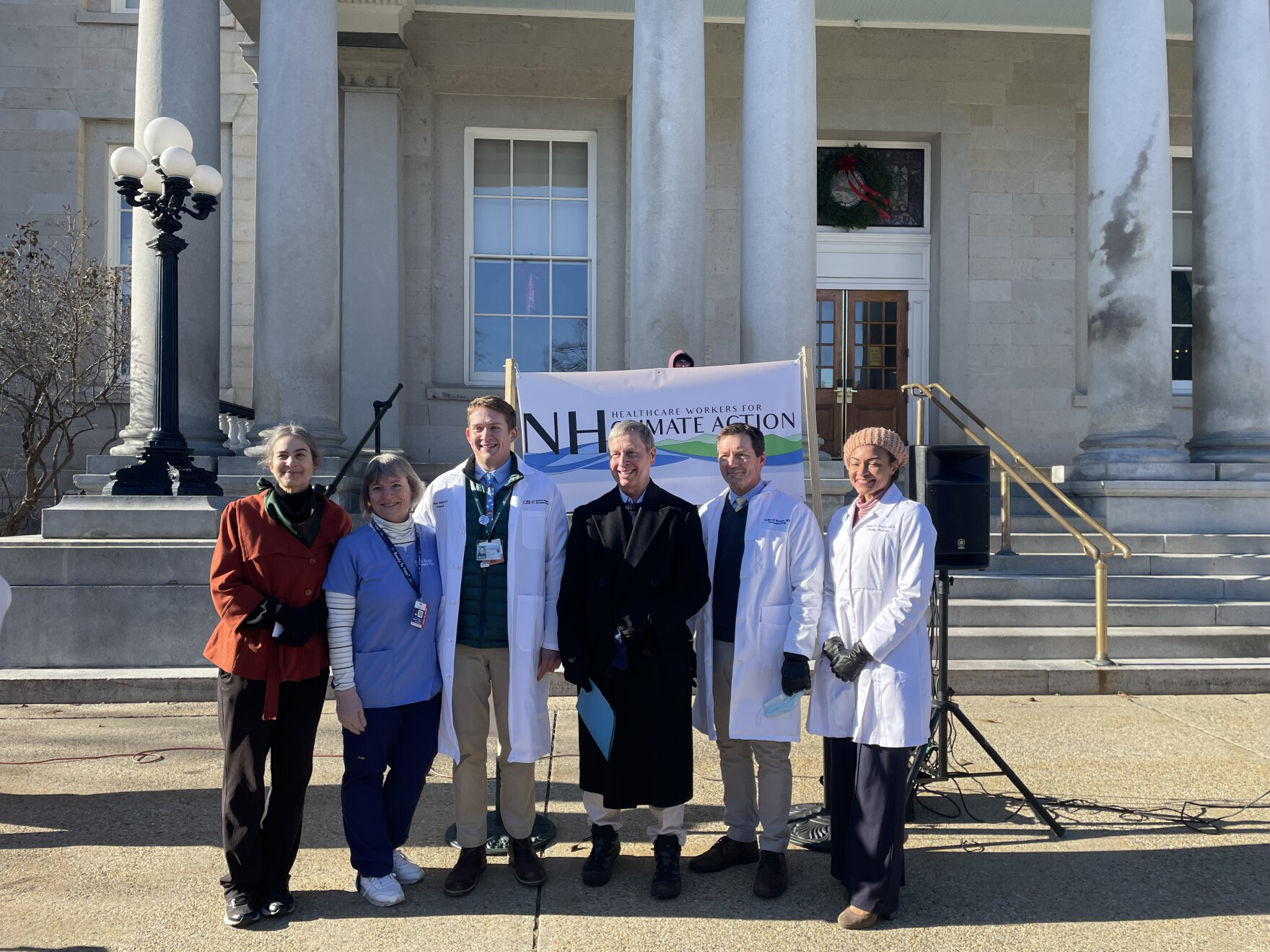
Former Governor John Lynch stands with members of New Hampshire Healthcare Workers for Climate Action in front of the State House. (Photo by Mara Hoplamazian/NH Public Radio)
A new group of New Hampshire healthcare workers is hoping to start conversations about climate change in the doctor’s office and with state leaders.
A recent report from the World Health Organization called climate change the “single biggest threat facing humanity.” And New Hampshire’s Department of Health and Human Services says climate change will likely affect health in the Granite State, from heat injuries to asthma to infectious disease.
New Hampshire Healthcare Workers for Climate Action is hoping to mobilize support for climate solutions by educating health professionals and state leaders on how climate change could impact our health.
At a public launch event at the State House on Dec. 4, former Governor John Lynch joined health professionals and state legislators to talk about why it’s necessary to take action. His newly arrived granddaughter Charlotte came along.
“This is about Charlotte and the New Hampshire she will live in when she’s 30 years old,” Lynch said to the crowd. “This is the story of two different futures.”
Lynch described the way climate change could cause more drought and flood, increase diseases carried by ticks and mosquitos, and cause coastal beaches to disappear as sea levels rise.
“The problem is, by the time she gets of an age where she can do something about it, it’s going to be too late. So we have to do something about it now,” he said.
The audience at the Dec. 4 event included state lawmakers Congressman Chris Pappas and Congresswoman Annie Kuster.
Action on climate change has been controversial in the New Hampshire Legislature, and New Hampshire lags neighboring states on certain climate actions, like creating mandates for greenhouse gas reductions.
New Hampshire Healthcare Workers for Climate Action has circulated a letter calling on state leaders to transition away from the use of fossil fuels, among other actions on climate change. In the letter, healthcare professionals say they’ve already started to see how climate change is harming their patients.
Unique opportunity
Bob Dewey, who’s on the board of the organization. is a retired cardiologist, and he says heat extremes, which are rising due to climate change, have a big impact on cardiac patients.
“On those hot days we would always see a lot more cardiac patients come into the emergency room with worsening kidney function, lightheadedness, a lot of people passing out from dehydration,” he said.
Rising heat is also a concern for some school-aged children, especially for schools without air conditioning, said Linda Compton, a school nurse and representative of the New Hampshire School Nurses Association. She says she’s also seen increases in asthma.
And the impacts of climate change might not be the same for all people in New Hampshire.
Dr. Marie-Elizabeth Ramas, a physician in Nashua, said adverse health outcomes from environmental factors are impacting residents of the Granite State differently based on factors like race and age.
Ramas spoke to the crowd about her experience of climate change in the doctor’s office.
“As a family physician with over 13 years of experience working for both rural and urban under-resourced communities, I can share firsthand experiences of adverse outcomes due to the effects of climate change,” she said.
Starting conversations with patients about how their environments impact their health, from sharing best practices on lead to discussing how to stay safe from rising tick populations, is already part of Ramas’s work. In her speech, she welcomed other healthcare workers to begin incorporating climate considerations into their clinical practices.
Bob Friedlander, founder of New Hampshire Healthcare Workers for Climate Action and a retired physician and community organizer, says he started the nonpartisan group after he realized the voices of healthcare workers were missing from conversations about climate change in New Hampshire.
In an interview with NHPR in October, Friedlander said healthcare workers have a unique opportunity to reach people.
“When a healthcare worker looks at you as a patient or a family member and talks to you about climate and health and its relationship to your own health ... that’s a whole different message,” he said.
This article is being shared by partners in the Granite State News Collaborative. For more information, visit collaborativenh.org.