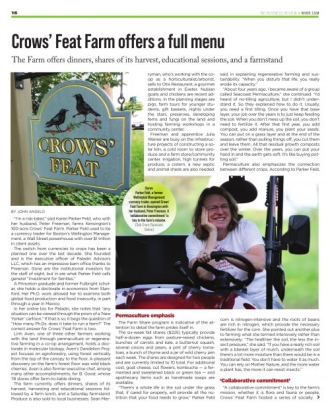
The Farm offers dinners, shares of its harvest, educational sessions, and a farmstand
Karen
Parker Feld, a former Wellington Management currency trader, opened
Crows’ Feat Farm in Kensington with her husband, Peter Freeman. A
‘collaborative commitment’ is key to the farm’s mission. (Deb Cram/Seacoast Online)

“I’m a risk-taker,” said Karen Parker Feld, who with her husband, Peter Freeman, farms Kensington’s 100-acre Crows’ Feat Farm. Parker Feld used to be a currency trader for Boston’s Wellington Management, a Wall Street powerhouse with over $1 trillion in client assets.
The switch from currencies to crops has been a planned one over the last decade. She founded and is the executive officer of Paladin Advisors LLC, which has an impressive barn office thanks to Freeman. Gone are the institutional investors for the staff of eight, but in are what Parker Feld calls general “investment for families.”
A Princeton graduate and former Fulbright scholar, she holds a doctorate in economics from Stanford. Her Ph.D. work allowed her to examine both global food production and food insecurity, in part through a year in Mexico.
In her online bio for Paladin, she notes that “any situation can be viewed through the prism of a ‘New Yorker’ cartoon.” If that is so, it begs the question of “How many Ph.Ds. does it take to run a farm?” The correct answer for Crows’ Feat Farm is two.
Linh Aven, one of three other farmers working with the land through permaculture or regenerative farming in a co-op arrangement, holds a doctorate in molecular biology. Aven’s Dandelion Project focuses on agroforestry, using forest vertically from the top of the canopy to the floor. A pleasant discovery on the farm’s forest floor was wild black cherries. Aven is also former executive chef, among many other accomplishments, for B. Good, whose 78 stores offer farm-to-table dining.
The farm currently offers dinners, shares of its harvest, harvesting and educational sessions followed by a farm lunch, and a Saturday farmstand.
Produce is also sold to local businesses. Sean Merryman, who’s working with
the coop as a horticulturalist/arborist, sells to Otis Restaurant, a
gourmet establishment in Exeter. Nubian goats and chickens are recent
additions. In the planning stages are pigs, farm tours for younger
students, gift baskets, nights under the stars, preserves, developing
ferns and fungi on the land and hosting farming workshops in a community
center.
Freeman and
apprentice Julia Weiner are busy on the infrastructure projects of
constructing a solar kiln, a cold room to store produce and a farm
store/community center. Irrigation, high tunnels for produce, a cistern,
a new septic and animal sheds are also needed.
Permaculture emphasis
The Farm Share program is indicative of the attention to detail the farm prides itself in.
The
six-week fall shares ($225) typically provide half-a-dozen eggs from
pasture-raised chickens, bunches of carrots and kale, a butternut
squash, several onions and pears, a pint of cherry tomatoes, a bunch of
thyme and a jar of wild cherry jam each week. The shares are designed
for two people and are currently limited to 10 total. For additional
cost, goat cheese, cut flowers, kombucha — a fermented and sweetened
black or green tea — and apothecary items such as handmade soaps are
available.
“There’s a
whole life in the soil under the grass that, if cared for properly, will
provide all the nutrition that your food needs to grow,” Parker Feld
said in explaining regenerative farming and sustainability. “When you
disturb that life, you really erode its capacity.”
“About
four years ago, I became aware of a group called Seacoast
Permaculture,” she continued. “I’d heard of no-tilling agriculture, but I
didn’t understand it. So they explained how to do it. Usually, you need
a first tilling. Once you have that base layer, your job over the years
is to just keep feeding the soil. When you don’t mess up the soil, you
don’t need to fertilize it. After that first year, you add compost, you
add manure, you plant your seeds. You can put on a grass layer and at
the end of the season, rather than pulling things off, you cut them and
leave them. All that residual growth composts over the winter. Over the
years, you can put your hand in and the earth gets soft. It’s like
buying potting soil.”
Permaculture also emphasizes the connection between different crops. According to Parker Feld, corn is nitrogen-intensive
and the roots of beans are rich in nitrogen, which provide the necessary
fertilizer for the corn. She pointed out another plus to farming what
she termed intensively rather than extensively: “The healthier the soil,
the less the insect pressure,” she said. “If you have a really rich
soil with a blanket layer of mulch, underneath the soil there’s a lot
more moisture than there would be in a traditional field. You don’t have
to water it as much. You can rely on Mother Nature, and the more water a
plant has, the more it can resist insects.”
‘Collaborative commitment’
“A
collaborative commitment” is key to the farm’s mission, whether it is
flora and fauna or people. Crows’ Feat Farm hosted a series of socially distanced
patio and lawn concerts the last two summers. When Parker Feld and
Freeman had to cancel a vacation to Acadia National Park in the spring
of 2020, they decided to invest the money saved into the infrastructure
necessary to hold outdoor concerts. There were hardware investments in
an open-air tent, electricity and staging but also a lengthy negotiation
process with the town board and the police and fire chiefs. She’s
thankful to town officials for making the concerts happen, though she
chuckled over reassurance she had to make that it wouldn’t be “another
Woodstock.”
Despite
the capital outlay, Crows’ Feat Farm donated the entire amount of the
$20 suggested price for concert admission to the musicians.
“The
concerts were a godsend,” said singer/songwriter Rodney Mashia. “Unlike
some settings, I could play my own music for so many people. The income
was greater by a factor of nine or 10 to what I usually play to.”
According
to Parker Feld, the farm donated most of its 2020 crop to Exeter’s St.
Vincent de Paul’s food pantry, citing both the need in the community and
the farm still developing marketing channels for its harvest. The
Kensington Community Church, which has a garden on the farm, did the
same.
Elizabeth
Haskett, the farm’s chef and livestock manager, and Weiner moved to
Kensington from Brooklyn within the last year. They were business
partners in a Brooklyn bistro called Greenpoint Heights. Weiner is a
paid apprentice. Haskett, Merryman, Aven and Chris Hitzel, who handles
the farm’s web presence, are investing in the farm’s
co-op, which Parker Feld and Freeman head. The plan is for the couple to
deed the farm, structures and equipment, aside from residential
buildings, to the co-op.
Haskett
conceived the popular farm dinners, which host 25 to 30 people and
quickly sell out at $75 per person. She and Aven prepare the meals.
Haskett
has worked on Long Island vegetable farms and spoke to the intricacies
of matching grains and negotiating knots while operating the farm’s
non-computerized sawmill. The wood, needed for infrastructure
development and improvement, is harvested from the land and dried in the
solar kiln.
Weiner’s advice on moving from Brooklyn to a New Hampshire farm is succinct: “Be prepared to slow down.”
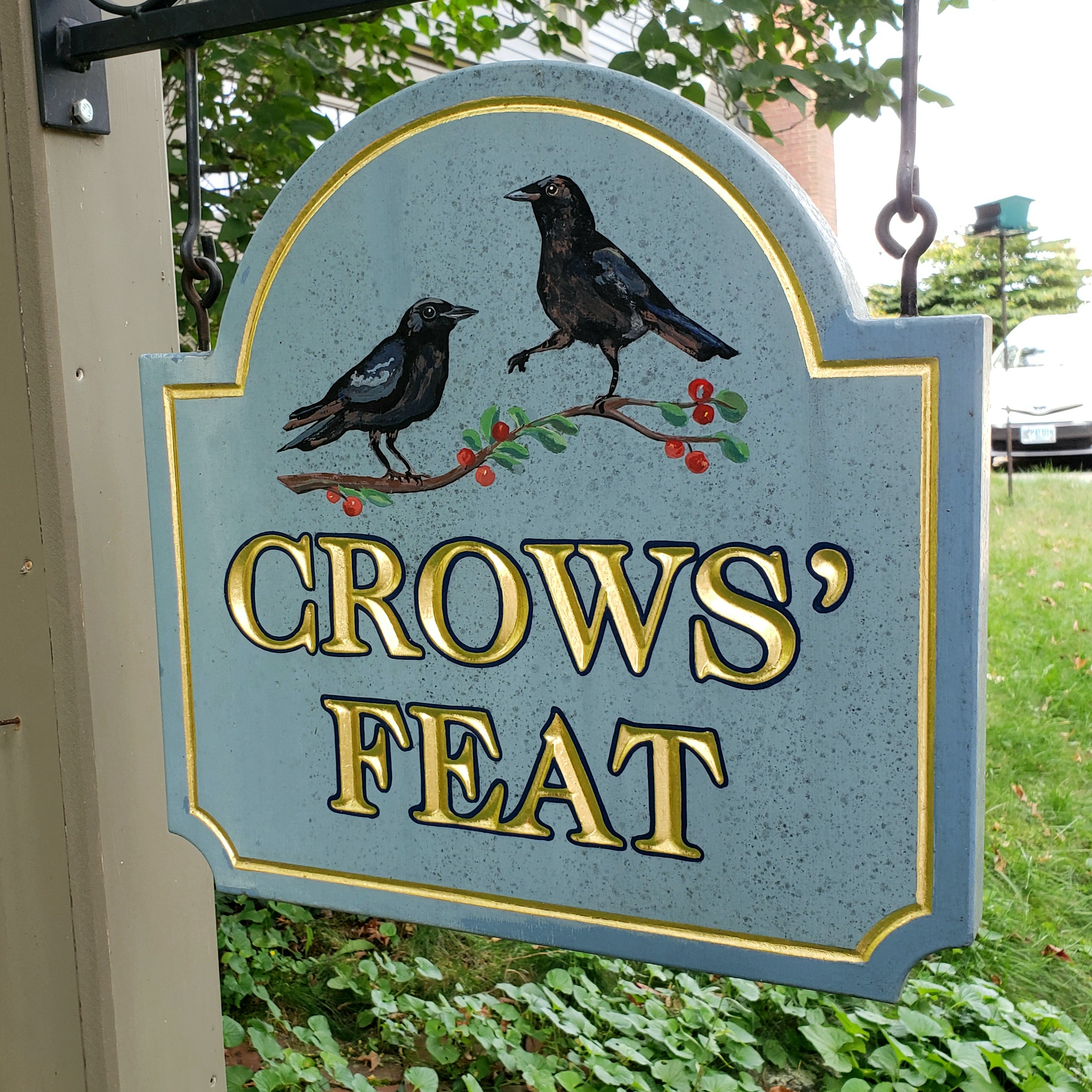
Parker
Feld, who was living on the Seacoast, came up with the name “Crows’
Feat” before the farm. “The idea was like this is quite an
accomplishment for a middle-aged woman!“ she said. “Crow’s feet come
from laughing, wisdom and hard experience, but I’ve also always had a
fascination with crows.” She cited their intelligence and ability to
work in pairs.
Parker
Feld also admired the land on Drinkwater Road in Kensington before it
was up for sale. She recalled an evening driving past it with the
illumination from the farmhouse playing across a snowfield and thinking
it was one of the most beautiful things she’d ever seen.
“I am an investor, but I did not treat this as an investment,” she explained. “I was just instinctively drawn to the place.”