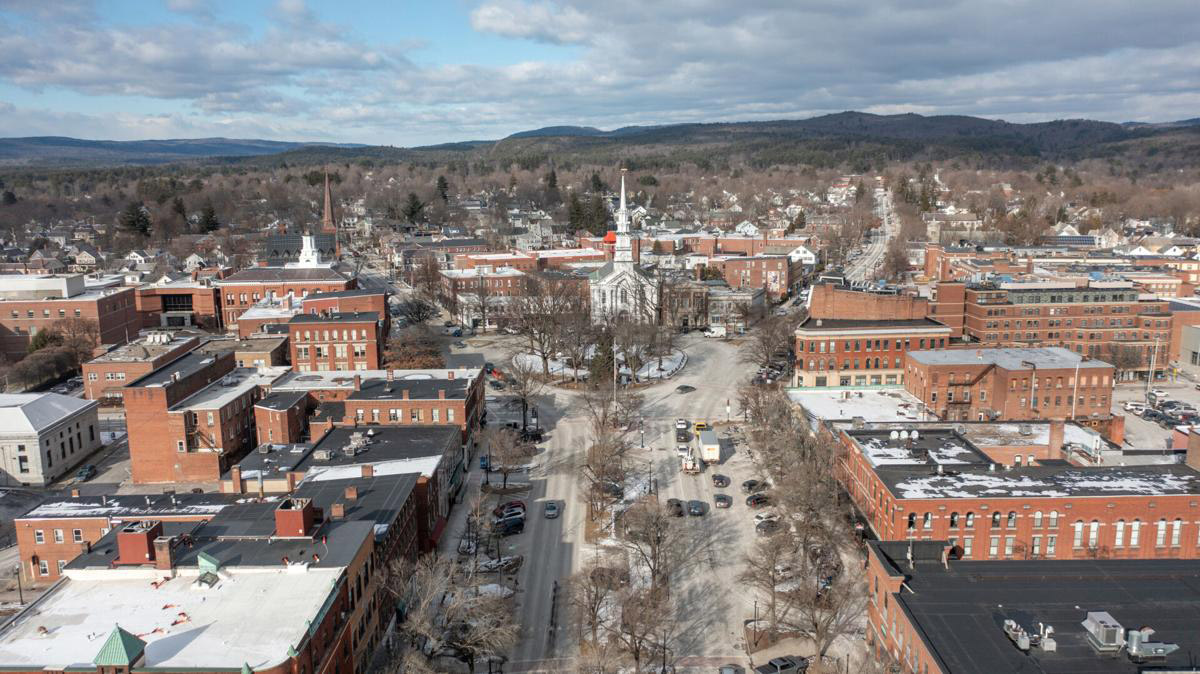
An aerial image, taken by drone, of downtown Keene in January. (Photo by Ethan Weston)The Keene City Council on Thursday, Sept. 4 approved a series of cost-cutting items to reduce the price tag of the downtown infrastructure project.
Keene officials also said at the meeting that the city can pay for the rest of the cost increases without affecting taxes.
The cuts made Thursday are expected to save the city roughly $3 million. These include shortening the project timeline from three to two years, forgoing construction work on Gilbo Avenue and Church Street, listing certain parts of the project as optional and reusing existing LED light fixtures.
The measure passed 13-1, with Councilor Philip Jones the sole dissenter. Councilor Thomas Powers was absent.
The primary purpose of the project is to replace aging pipes beneath downtown Keene, though several above-ground modifications are also planned.
Thursday’s vote is the latest chapter in the infrastructure plan saga. It came after a recent estimate that the project would cost the city $5.5 million more than initially thought: $22.86 million instead of $17.4 million. The total figure excludes the roughly $550,000 the city already spent on the design. Earlier this year, councilors voted to delay the project, which was scheduled to start in the spring, until 2026.
The council’s action reduces the cost to roughly $20 million.
“In order to carry out the project, which had increased pretty substantially in cost, some big changes had to be made,” said Councilor Mitch Greenwald, who heads the municipal services, facilities and infrastructure committee, which brought the recommendations to the full council.
Greenwald said the increased costs will not affect property taxes, as city staff have been able to find additional money “through creative looking at other projects and fund balances.”
Some of these changes involve delaying projects on Ash Brook Road and Court Street, City Manager Elizabeth Ferland said. Those two projects included replacement of road signals and a culvert, respectively, according to the municipal services committee’s recommendation.
Bidding on the infrastructure project is scheduled for mid-September, about a month and a half after officials learned the project lost out on a $13.7 million federal grant that would have covered more than half of the overall cost.
In January, councilors voted 11-4 to delay the project until 2026. Councilors who voted in favor of postponing said the extra time would benefit downtown businesses whose owners had pleaded for a delay, and that replacing the aging pipes underground could wait a bit longer.
In the meantime, prices have gone up, Greenwald said at Thursday’s meeting. Stantec, the city’s consultant, also added materials costs to the estimate when it became clear more supplies were needed, he said.
But the cost-cutting measures come with tradeoffs. Shortening the project timeline to two years will mean larger construction zones and more disruptions to downtown businesses, Greenwald said.
“Yes, it will create more chaos and difficulty during the construction, but what we’re hearing from the downtown community merchants and building owners (is) ‘Let’s get it over with. Let’s start the construction and end it quickly,’” he said.
“It’s going to be intense; it’s going to take a lot of cooperation and hopefully we’ll come up with some creative ideas to help the downtown community get through this project.”
Among the changes the council approved Thursday night was a measure that nixed utility work on Gilbo Avenue and Church Street, for a total savings of $2.3 million. The Gilbo Avenue work was “to prepare the area for anticipated development,” according to the municipal services committee’s recommendation.
This article is being shared by partners in the Granite State News Collaborative. For more information, visit collaborativenh.org.