How life sciences are shaping New Hampshire’s economic future
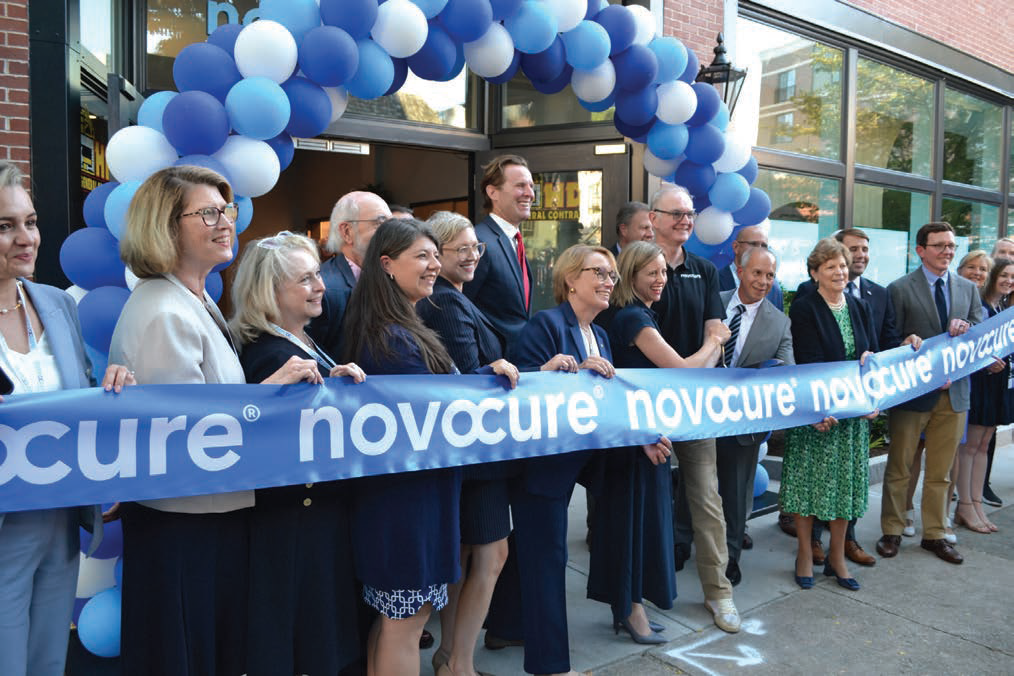
Novocure
personnel, along with local and state elected officials, crowd in front
of the ribbon for the official opening Sept. 3, 2024, of the company’s
new U.S. headquarters in downtown Portsmouth. Holding the ceremonial
scissors at right center is Ashley Cordova, who was elevated that day
from chief financial officer to chief executive officer, replacing Asaf
Danzigner who is retiring at the end of the year. (Photo by Paul Briand) ECONOMY
Life sciences aren’t new to New Hampshire. For decades, pioneering companies in biotechnology, medical devices, diagnostics and advanced manufacturing have contributed to the state’s economy, often operating independently, without a unified voice or shared identity. But that changed in 2022, when the state of New Hampshire released a report and recognized life sciences as a strategic economic priority.
Later that year, NH Life Sciences (NHLS) was formed to champion the sector, connect stakeholders and share the state’s story with the world. Now, through public-private collaboration and renewed visibility on the international stage, life sciences in New Hampshire are stepping into the spotlight, not as a collection of independent businesses but as a high-potential cluster with growing momentum.
The state’s strategic spotlight on life sciences
Proximity to Boston-Cambridge’s life sciences ecosystem spurred an expansion into New Hampshire, building on its manufacturing roots and business-friendly policies.
The success of the natural progression of life sciences served as evidence of the industry’s growth potential, accelerated with state support.
“We’re right up the road (from Boston), and we offer a lot of benefits you can’t get in Massachusetts,” said Taylor Caswell, commissioner of the New Hampshire Department of Business and Economic Affairs.
New Hampshire’s state budget is one of the lowest per capita in the country, so leaders put considerable thought into where they are spending limited resources.
Caswell
noted that the life sciences report showed it was an industry where the
state could see the most benefit from the investment.
By
partnering with nonprofits like NHLS, the state sees the opportunity to
expand its efforts to grow the life sciences industry and share
companies’ successes.
The BEA helped sponsor the
NHLS booth space at the recent BIO International Convention in Boston.
The state felt it was important to recognize that New Hampshire is
worthy of sharing the floor with global life sciences clusters and to
have conversations with delegations and companies interested in
investing in the state.
“NHLS as the messenger accelerates the reach of the story,” Caswell said.

From
left: U.S. Deputy Commerce Secretary Don Graves, ARMI (Advanced
Regenerative Manufacturing Institute) Executive Director Dean Kamen and
U.S. Sen. Jeanne Shaheen listen to Jodie Nazaka, economic development
director for the City of Manchester, during a trolley tour of the
Millyard and downtown Manchester on July 2, 2024. (Photo by Kendal Bush, ARMI)
Benefits the state offers to life science companies
New
Hampshire is an attractive state for life science businesses looking to
grow. Mark Laliberte, BEA’s business development manager, spoke with
BIO attendees on some of the benefits a company might leverage.
Among the benefits is the state’s tax structure. There are no
state sales or income tax. The Business Enterprise Tax (BET) rate is
0.55%, and the Business Profits Tax (BPT) rate is 7.5%.
While the state does have high property taxes, its overall tax burden
was ranked the third lowest in the country in a recent WalletHub
comparison.
Additional
financial incentives include an R&D tax credit, which currently has
legislation pending to increase both the individual award and the total
available funds. A Regenerative Manufacturing Tax Exemption is
available to businesses involved in regenerative manufacturing, which
exempts them from the business profits and enterprise taxes for 10
years. The Regional Economic Development Center offers grants for
machinery purchases to qualifying micro-businesses.
The federal government recognized the region spanning New Hampshire’s largest cities, Manchester to Nashua, as the ReGen
Valley Tech Hub, led by the Advanced Regenerative Manufacturing
Institute (ARMI). This designation provides funding to projects to
advance biofabrication therapies, train the workforce and invest in
manufacturing facilities. In 2024, the ReGen Valley received a $44
million U.S. Economic Development Administration Build Back Better
Regional Challenge grant.
These benefits can help a startup mitigate some of the expenses of development before its concept becomes a retail product.
How life sciences benefit New Hampshire
New
Hampshire is investing in benefits to attract life sciences, because
the state sees the economic ripple effects from the industry.
The
BEA report showed that life sciences contributed $2.8 billion to New
Hampshire’s gross domestic product in 2021, about 3% of the state
economy. From 2012 to 2021, life science jobs in New Hampshire increased
15% and were expected to continue increasing at a rate of 6% from 2021
to 2026.
Life sciences workers, on average, earn significantly more than other industries, further boosting the state’s economy.
There
is also a multiplier effect from life sciences that results in new jobs
in supporting industries. According to the BEA report, a multiplier is a
way of measuring how strongly one industry affects other industries,
services and spending in that region.
A
jobs multiplier, for example, indicates how important an industry is in
regional job creation; a job multiplier of 3 would mean that for every
job created by that industry, two other jobs would be created in other
industries for a total of three jobs. For New Hampshire’s life science
cluster, the multipliers indicate that these industries are highly
impactful to the economy.
For
the cluster as a whole and for each industry group, the multipliers are
all above 1.5, and many exceed 2. The jobs multiplier relates that, for
100 life science jobs in the state, there are another 130 jobs in other
sectors due to further spending and investment.
The
research and development dervices and medical equipment and supplies
manufacturing industry groups are key employment generators; they have
jobs multipliers that are well over 2, meaning that their economic
footprint is more than double their direct activity.
A road map for continued momentum
NHLS
continues to advocate for policies and pipelines that grow the life
sciences and support the state’s goals. Working with members and
partners, it is developing a workforce pipeline at the community college
and university level.
It
is connecting companies with resources and experts through events and
networking. It’s also advocating for policies that support startups,
expanding global companies and Granite State institutions adapting to
evolving needs.
Overall,
the industry organization is finding new ways to share the stories of
life science companies finding success here and guiding others to the
same achievement.
While
New Hampshire may be just up the road from Boston, it’s forging its own
path to be a leading life sciences cluster, buoyed by state priorities
and member support.
For
companies looking to join the rising tide of life sciences benefits in
New Hampshire, find out how membership can support your goals. Learn
more at nhlifesciences.org/membership.


