As the largest purchaser of goods and services in the world, the U.S. government is a customer worth pursuing for New Hampshire businesses of all sizes, but breaking into this market requires careful planning and strategic partnerships, which was the overarching theme of the New Hampshire Tech Alliance’s recent inaugural Northeast National Security Conference.
Held June 10 at Saint Anselm College in Manchester, the networking event featured a variety of speakers in the government defense and national security sectors who shared firsthand insights into the most pressing technological needs of the U.S. Department of Defense (DoD) and how commercial companies and startups, including those in New Hampshire, can get involved.
“We recognize that, as we race to outpace our adversaries, we must be able to harness the innovations and cutting-edge technologies that small businesses provide,” Lt. Gen. Philip Garrant, commander of Space Systems Command (SSC), said in a keynote.
SSC
has “dedicated significant resources toward industry outreach,”
strengthening existing partnerships and establishing relationships with
new businesses, Garrant added.
During
a forum held at the event on investing in national security, a panel of
venture capitalists (VCs) shared how small businesses and startups can
survive the “valley of death,” a term used to describe the critical
startup phase of a new venture that has begun work on a product or
service but that does not yet have a sufficient revenue stream. In these
early development stages, funding is critical, as are building the
right partnerships.
The
No. 1 job of any founder is “to make sure that your team has enough
capital,” said Laura Rippy, managing partner at Alumni Ventures, a
Manchester-based venture capital firm. “Have a backup plan and plan
creatively,” she said.
An
example would be “lining up venture debt at the point that you raise
your round, not when your back is against the wall,” Rippy said. In
laymen’s terms, secure financing early, providing the business with
enough capital to sustain operations and support its growth.
“Be
mindful of who is on your cap table, because that in a lot of ways is
going to … carry you to the next round,” said Chip Walter, managing
director at Marlinspike Partners, a venture capital firm that invests in
dual-use technologies. A “capitalization table” shows who has equity
ownership in the business and how much.
Pay
attention to how deep the pockets are of the lead investor and “their
history of supporting portfolio companies in times of difficulty,” Rippy
advised. If the lead investor does not have enough reserve capital to
help the business through the rough patches, then the business “can
easily get stranded in that valley of death.” Conversely, if there is a
large fund that recognizes that milestones aren’t always going to be
hit, the capital will be there to bridge the gap, she added.
Ongoing engagement
The
VCs on the panel also stressed the importance of engagement.
Public-private partnerships between seed investors and startups are
important for sourcing funding. “The tighter you wind those together,
the more the benefit,” Rippy said.
The
most difficult stages for startups are the Series A and Series B
funding stages, but opportunities can be unlocked by building bridges to
the next round of funders, Rippy added. “Start to get hooks on the
Series A leads,” she advised. “That’s where you start to plant the seed
for longer-term growth.”
“You
need early engagement,” said Sherman Williams, co-founder and managing
partner at AIN Ventures, a venture fund that invests in dual-use
technologies and veteran-led startups. Getting through the valley of
death is “not some monolithic block. At the end of the day, these are
people,” Williams said, adding that face-to-face engagement goes a long
way.
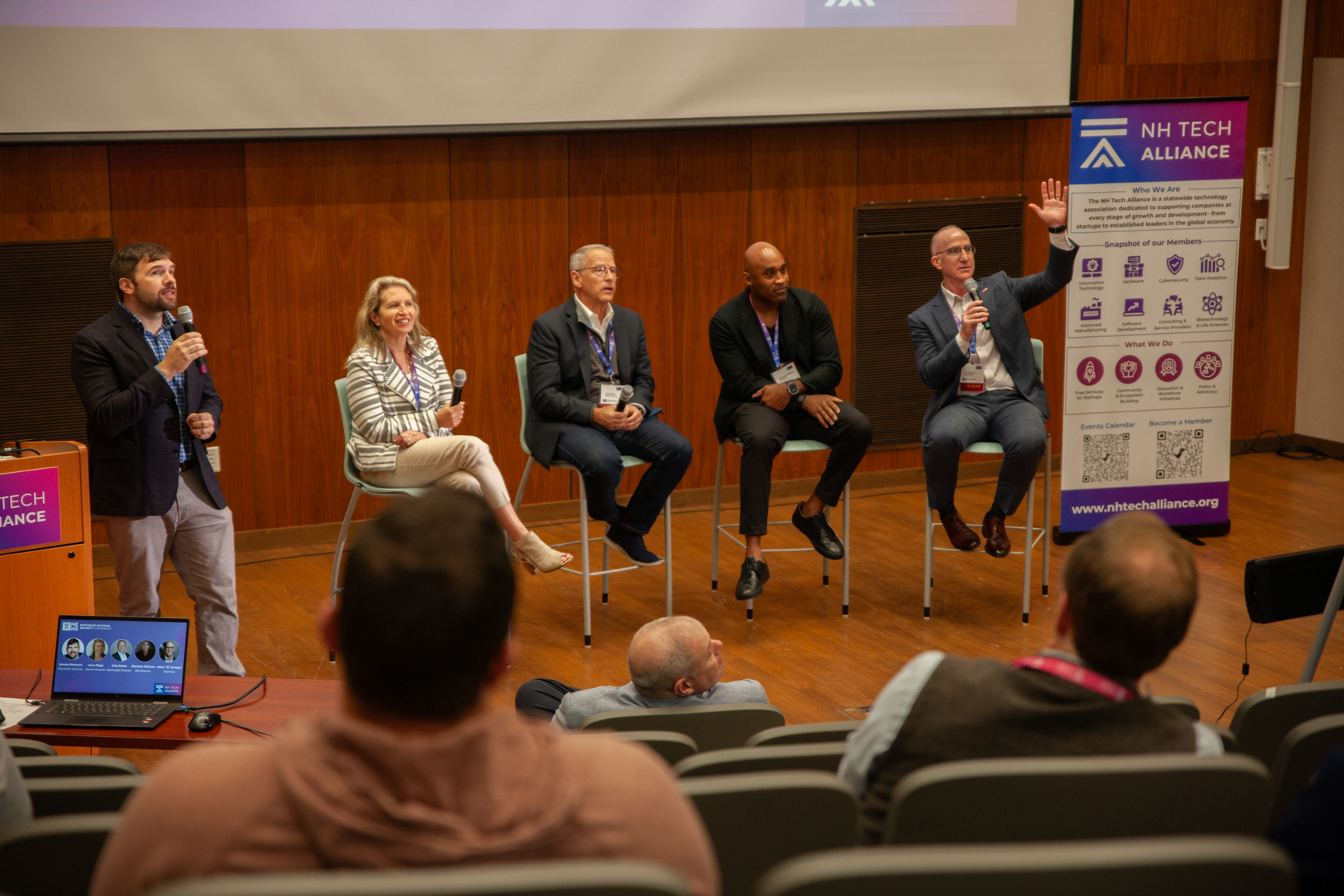
Jeremy
Hitchcock, New North Ventures; Laura Rippy, Alumni Ventures; Chip
Walter, Marlinspike Partners; Sherman Williams, AIN Ventures; and Adam
“AJ” Jarnagin, Expansia, discussed how small businesses and startups can
survive the “valley of death” during a June 10 forum on investing in
national security hosted by the NH Tech Alliance. (Photo by James Huddleston, EA Creative)
Small-business resources
Small
businesses, including those in New Hampshire, have many resources
available to them to navigate the government contracting process. Two of
those resources are the Small Business Innovation Research (SBIR)
program and the Small Business Technology Transfer (STTR) program,
Williams noted.
Powered
by the Small Business Association (SBA), both the SBIR and STTR
programs provide equity-free funding through 11 participating federal
agencies to small businesses to help fund their advanced technology
innovations and pave a path toward commercialization.
Many
states have regional resources for small businesses as well. In New
Hampshire, for example, there is the Procurement Technical Assistance
Center (NH PTAC), which is a cooperative program between the NH
Department of Business and Economic Affairs (BEA) and the DoD’s Defense
Logistics Agency.
On
its website, NH PTAC states that it offers free, confidential assistance
to businesses of all sizes to help them navigate the many facets of the
government contracting process. NH PTAC also offers training for
businesses just getting started in federal procurement, and sponsors
events like “Matchmaker,” which bring together small businesses and
prime contractors.
PEO engagement
Williams
remarked that engagement with the relevant U.S. Military Program
Executive Office (PEO) is also important. PEOs play a critical role by
overseeing the entire lifecycle of the U.S. military’s acquisition
process. Each PEO manages the acquisition program within each department
of each of the six branches of the U.S. Military: Army, Marines, Navy,
Air Force, Space Force and Coast Guard.
In
his keynote remarks, Garrant said for businesses interested in
connecting with SSC, for example, “I recommend that your first stop be
our Front Door,” which is accessible through the SSC’s web page. “The
Front Door acts as our switchboard to direct you to the program that
best addresses and supports your ideas.”
There’s
also the SSC Small Business Office, which “works very closely with the
acquisition team within SSC to make sure we are reducing barriers to
entry for small businesses and including small businesses in our
acquisition processes and strategy,” Garrant said. Last year, SSC
awarded over $990 million to qualified small businesses, he said.
Because
each department within each branch of the military has its own unique
needs, small businesses and startups may want to consider partnering
with former military personnel with government procurement experience to
help them navigate the complex web of
federal acquisition rules and regulations and to help them understand
the unique needs of each department, Williams said.
AIN
Ventures, for example, is “deeply connected” with PEOs through its
Academy Investor Network syndicate, made up of hundreds of academy
graduates, including admirals, generals, fighter pilots, astronauts and
more. “We leverage that group pretty heavily to get to the DoD,”
Williams said.
NH defense contracts by the numbers
According
to data provided by the Office of Local Defense Community Cooperation,
defense spending totaled $2.5 billion in New Hampshire in fiscal year
2023, representing 0.4% of total U.S. defense spending. The majority of
contracts are for supplies and equipment.
Hillsborough
County is, by far, consistently the top location for defense contract
spending, totaling $1.4 billion in fiscal year 2023, followed by
Rockingham County, with $449.2 million in defense contract spending.
The
top five largest NH defense contractors in FY 2023 were BAE Systems, L3
Harris Technologies, Red River Technology, Sig Sauer and the Safran
Group. Other defense contractors in the state are Solid State Scientific
Corp., Expansia Group, Wilcox Industries Corp., Port City Air and
Teledyne Technologies.
But
it’s not just large corporations that are awarded federal contracts in
New Hampshire. According to the NH BEA, over 23% of all federal
government contract spending goes toward small businesses, “including
hundreds of New Hampshire companies.”
It’s
important to keep in mind that, at times, the DoD may change course
simply because it can, Walter said. However, that shouldn’t discourage
any business from veering off course. Have patience. Be persistent. “If
you stay focused,” he said, “you have the best chance of working your
way through that valley.”


