At UNH Tech Camp, biofabrication, regenerative medicine are on the schedule
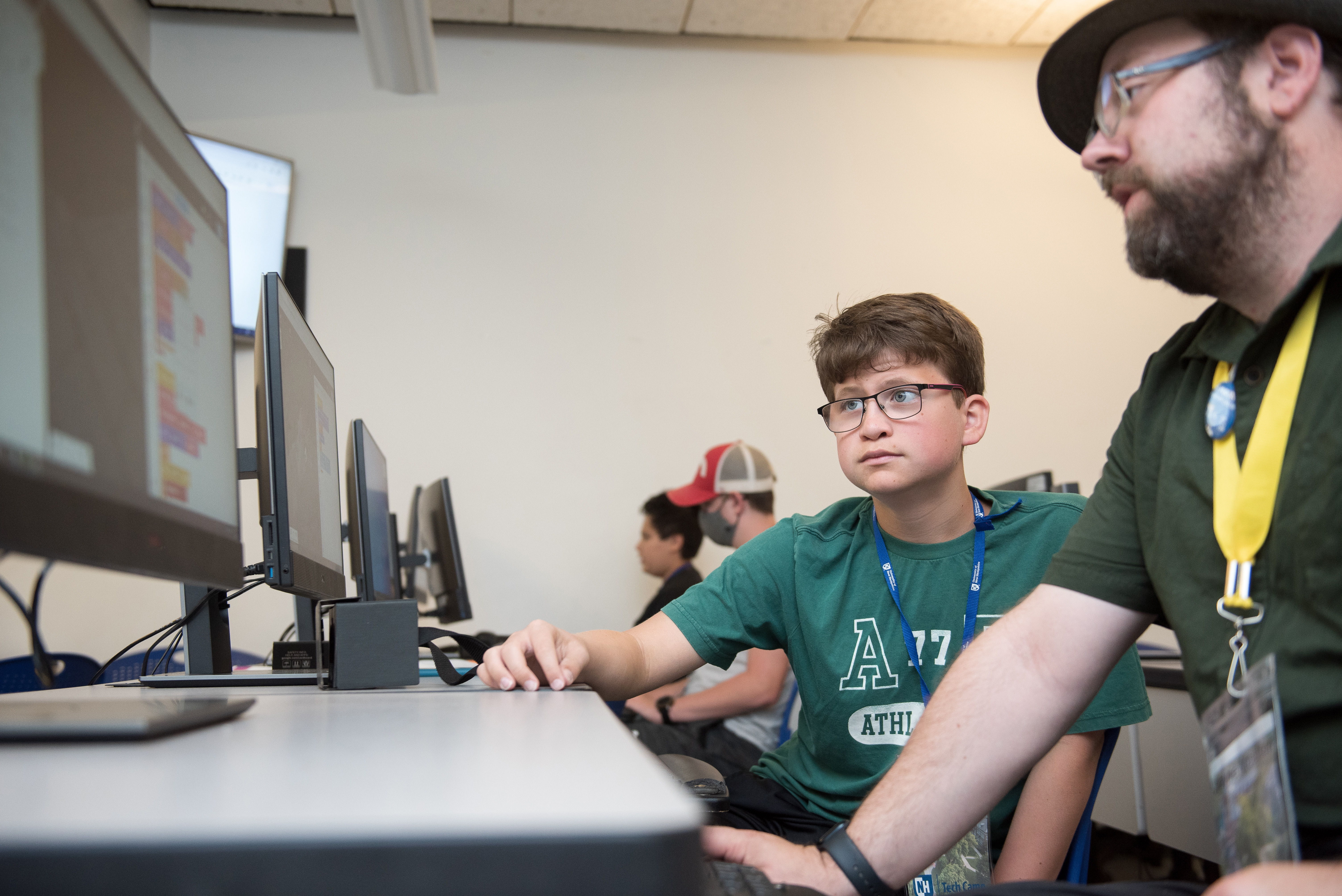
Gavin Fisher, 13, of North Hampton gets instruction from Wayne Moulton, a VR project leader at UNH Tech Camp. (Photos by Kate Brindley Photography)
Since 2007, the University of New Hampshire has been working toward bridging the gap between education and workforce development through a program called UNH Tech Camp.
Every summer, middle and high school students visit the UNH campus in Durham to collaborate with one another through activities focused on science, technology, engineering and mathematics (STEM).
Under the UNH Tech Camp umbrella, students can take part in such programs as Techsplorers for grades 5-8, Techventurers for grades 7-10, Techleaders for grades 10-12, the Dinah Whipple STEAM Academy. In addition, there’s Tech for Teachers, for K-12 teachers.
The camp is offered through the College of Engineering and Physical Sciences, which allows students in the summer program to access the school’s state-of-the-art facilities, advanced technology and even its faculty.
In 2011, the camp added special projects that include areas of focus such as regenerative medicine and biofabrication, thanks to support from NH CREATES, a workforce development initiative.
‘It takes a village’
Projects the camp offers run the gamut from rockets and physics of flight, structural engineering, automotive engineering, to forensics, molecular visualization, bioprinting, virtual reality, to pharmacology, cell therapies and much more.
“The Tech Camp is the center of a STEM ecosystem where teachers and diverse youth engage in emerging technologies,” said Carmela Amato-Wierda, director of the camp and an associate professor of materials science at the university. “We intentionally have people at the camp from all aspects of the STEM pipeline: undergraduates, graduate students, faculty, professionals from industry and government and career professionals.”
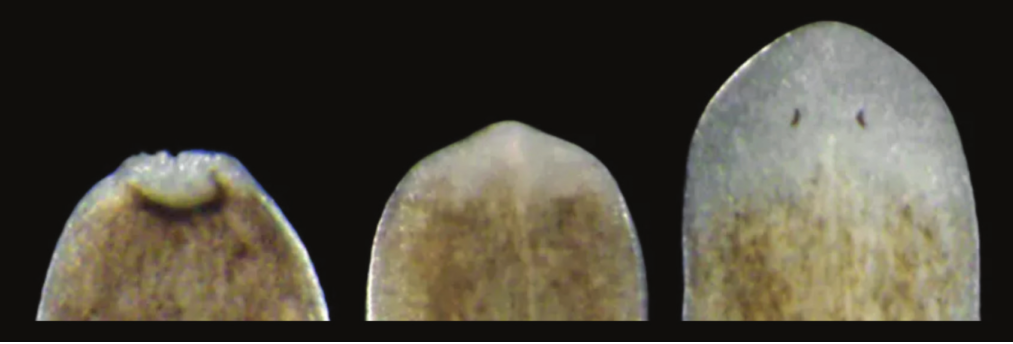
One of the many instructors at the Tech Camps is Dr. Jason Pellettieri, a professor in the Department of Biology at Keene State College. He joined the camp last year to share his background in cell and development biology with students, helping them to investigate cellular and molecular mechanisms of tissue regeneration in aquatic flatworms.
“Students in my Tech Camp course work with freshwater planarians, flatworms with the remarkable ability to regenerate (regrow) any lost body part in just over a week,” he said. “Specifically, the students conduct original, discovery-based projects examining the effects of environmental variables of interest (e.g., exposure to an over-the-counter medication or dietary supplement) on the rate of stem cell-mediated formation of new tissue at sites of amputation.”
Such research has been opening up doors to modern medicine that can benefit people in need around the globe, including here in New Hampshire, said Pellettieri. He also noted that the study of regenerative medicine can have a positive impact on New Hampshire’s economy, as exemplified in the ongoing Advanced Regenerative Medicine Institute (ARMI) project, which is housed in Manchester’s Millyard, a few blocks from UNH’s Manchester campus.
In fact, the camp has partnered with ARMI, along with, BAE Systems, Liberty Mutual, Portsmouth Naval Shipyard and the NH Department of Transportation in providing its programs.
Amato-Wierda shared that “it takes a village to get a child from youth to career (STEM or not). All children need that village, and Tech Camp aspires to be the STEM village for youth and teachers.”
That rounded approach to the camp is giving participating students an opportunity to explore possible career pathways they may have never once thought possible.
Said Amato-Wierda: “I remember one student who came on a full scholarship that said, ‘I never thought I could be an engineer. Being here at Tech Camp makes me feel like I can really go to college someday.’”
Support system
While the camp does come with a cost for students to participate — $600 per week for day students and $1,150 per week for residential students — financial assistance is available for everyone who qualifies, thanks to sponsors, donors and two federal grants.
 In 2020, the Tech Camp received a five-year, $1.2 million grant from the National Institutes of Health through its Science Education Partnership Award program for NH CREATES, which aims to help build a skilled workforce for New Hampshire’s regenerative medicine and biotechnology industries.
The grants were awarded to NH CREATES (the NH Collaborative for Regenerative Medicine Education and Training for Engineers and Scientists of the Future) to build on UNH Tech Camp’s curriculum to introduce underrepresented STEM-related fields to students of all skill levels.
The federal grants also fund a paid two-week summer program for teachers, the Tech for Teachers Institute, that provides training for middle and high school STEM teachers to aid in their development of projects related to regenerative medicine and biotechnology in their classrooms.
One teacher who participated in the institute, Shannon McCracken-Barber, a science teacher at Farmington Senior High School, brought what she learned into her classes, starting with a unit on biotechnology.
“In the main lesson, we mimic a process done by WPI (Worcester Polytechnic Institute), where they decellularized spinach leaves and then grew heart stem cells on them. This was done to see if a plant scaffold could reproduce the human vasculature for an organ, (something that has caused issues with organ creation for transplant),” she said. “We, of course, could not use stem cells like that, so we found a way to create ‘colored’ E. coli that students can visually observe growing across their leaves to symbolize the heart stem cells.”
Through such lessons, students get hands-on experience with cutting-edge technologies that are being used to solve worldwide challenges.
“Running an endeavor that provides resources to youth and teachers and puts technological equipment into their hands or classrooms is not free,” said director Carmela Amato-Wierda. “We are incredibly grateful to the people who make this happen.”
One of the Tech Camp’s industry partners is ARMI and its affiliated BioFabUSA, a nonprofit organization based in Manchester that works to advance the bioeconomy of the U.S.
Kathleen Hannabach, education and workforce development coordinator at ARMI, said, “The future of medicine is utilizing technology in fascinating ways once thought to be science fiction. The topics of the various UNH Tech Camps educate students about the advanced technology of regenerative medicine such as biofabrication, 3D bioprinting of organs and bioinformatics.”
She added that the “foundational skills learned and practiced in each of these dynamic camps provide realworld experiences that will further motivate students to explore biotech careers in traditional college tracks as well as training and certification programs completed in under a year.”
The promise shown in these programs even earned a visit in July by U.S. Sen. Jeanne Shaheen, who spent over two hours engaging with the students and faculty in classrooms. Her visit came after the passage of the CHIPS Act, which includes funding for STEM-related educational programs like UNH Tech Camp.
‘The next frontier of medicine’
While UNH Tech Camp does manage to squeeze in some fun between projects for students, the focus remains on education and preparing them for potential career pathways, with the hope of curbing the workforce development challenges New Hampshire has been facing in the past few years.
According to Julie Lenzer, chief innovation officer at BioFabUSA, “More than 25 percent of U.S. adults have a disability, half of whom have a functional disability impacting their mobility, cognition, hearing, vision, selfcare, and/or the ability to live independently” and donor tissue and organ transplants are often the only option for recovery from many of these conditions, but supply is far short of need.”
Currently, 106,000 individuals are on the national transplant waiting list. Seventeen of them die daily as they wait for a transplant. Lenzer added, “The impact of chronic disease and traumatic injury make clear that biofabrication — curing chronic disease and repairing traumatic injuries with engineered cells, cell therapies, tissues and organs — is the next frontier of medicine.”
To do this successfully, Lenzer said, ARMI and its members work to reach students to help motivate their curiosity to know more about the biotech industry and related careers.
“The skills taught within the UNH Tech Camp are essential to cultivating that awareness and exposing students to the career pathways that lead them to industry leaders, such as ARMI and our members,” said Lenzer.
With 16 projects being conducted by more than 180 students during three weeks in the summer, UNH Tech Camp is poised to build a strong foundation for New Hampshire students’ learning that directly translates into a brighter workforce in the future.
Amato-Wierda said, “Students come to us thinking technology is computers and robots, when in fact, technology is about the application of science and math to solve all types of problems for the betterment of humanity.”